How Oregon’s Own Voters Helped Break the Justice System
How Oregon’s Own Voters Helped Break the Justice System
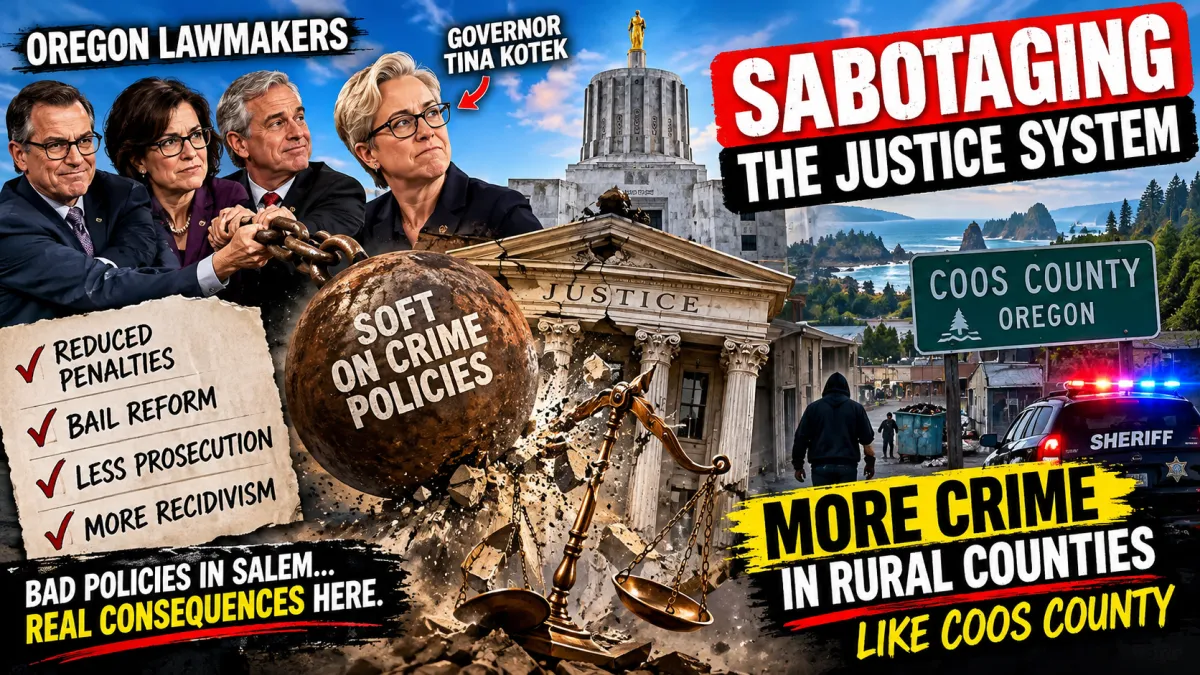
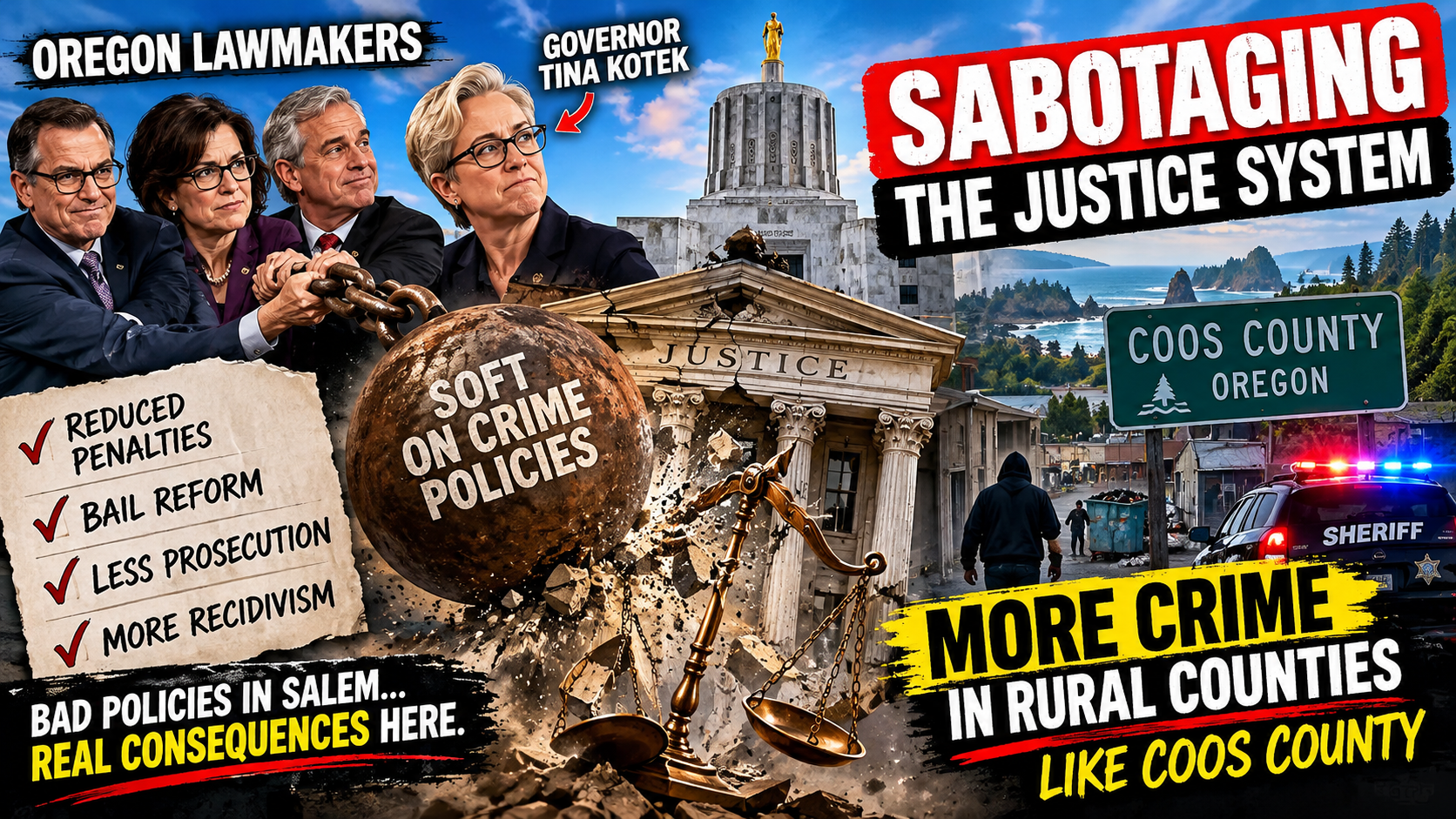
From Coos County’s overcrowded jail to struggling courts statewide, Oregon’s justice system is buckling. It is tempting to blame only lawmakers and the governor, but the deeper truth is uncomfortable.
The majority of Oregonians keep voting for the same leaders and extreme policies that created this crisis. The result is a self‑inflicted tragedy that is playing out in the streets in real time.
State Law, SB 48, and the Rules Counties Must Live With
To understand how this crisis took shape, it helps to start with the basic framework counties must operate within. Oregon counties do not design their justice systems from scratch. They operate inside a tight box drawn by state law, legislative mandates, and statewide political priorities. The Legislature — dominated for years by a Democratic supermajority that holds nearly every statewide office — sets the rules. Local officials then have to somehow make those rules work with whatever money their voters are willing to provide.
One example is Senate Bill 48 from the 2025 Regular Session (OLIS). SB 48 illustrates how the Legislature keeps adding complex pretrial release mandates and programs that reshape local budgets without fully funding the downstream impacts on public safety, courts, and jails.
Layered on top are the core rules of criminal procedure themselves. State law also dictates who can be held in jail, who must be released, and under what conditions. Pretrial release rules, risk‑assessment tools, bail limits, and speedy‑trial expectations all come from Salem. Counties like Coos must follow them, even when their facilities are full, their deputies are exhausted, and their budgets are bare‑bones. Local leaders are left managing the fallout while lawmakers in the capital talk about “reform” and “equity” in the abstract.
Judge Martin E. Stone’s Order and the Logic of Triage
These structural pressures are not hypothetical ideas. They land squarely on local judges' desks. Coos County has become a symbol of this slow‑motion breakdown. Judge Martin E. Stone, a long‑serving circuit court judge for Coos and Curry Counties, has been at the center of high‑stakes disputes, from complex statewide litigation to local capacity crises.
In other cases, he has issued detailed orders to force the state to turn over records or comply with its own obligations — a reminder that even judges are struggling to get straight answers and adequate support from Salem (School Trusts litigation summary).
Although Judge Stone's most visible 2026 order involved compelling document production in a school‑trust case, the same underlying tension applies to criminal justice, especially when local courts must triage. When jails are full, dockets are overloaded, and public defenders are scarce, judges must decide which cases move forward, which defendants stay in custody, and which are released or dismissed. Formal or informal capacity orders often tell sheriffs they cannot exceed a certain number of inmates. Once that ceiling is hit, someone has to go—even if law enforcement and the public see that person as a serious risk.
In Coos and Curry Counties, Presiding Judge Order No. 22‑01, First Amended, now governs triage under ORS 135.233 after the Legislature passed Senate Bill 48 (2021). That law required every judicial district to adopt a standing pretrial release order spelling out, in advance, which people and which crimes are:
subject to release on recognizance,
subject to release with special conditions, and
not eligible for release until arraignment.
Judge Stone’s order, effective July 1, 2023, does exactly what Salem told him to do. It adopts the Chief Justice’s statewide guidelines and the State Court Administrator’s Release Guidelines Categorization List, and then sorts every crime into three buckets — Crime Category 1, Crime Category 2, and Crime Category 3 — in language that tracks the statute almost word for word:
Crime Category 1 — The Sheriff or Release Assistance Officer “shall release on recognizance” with a standard release agreement under ORS 135.250 all individuals charged with: (a) any non‑person misdemeanor not listed in higher categories; (b) any non‑person Class C felony not listed in higher categories; (c) most driving‑while‑suspended offenses under ORS 811.182, except aggravated driving while suspended; and (d) any other offense not included in Crime Categories 2 or 3.
Crime Category 2 — The Sheriff or Release Assistance Officer “shall release on court‑imposed conditions” all defendants charged with: (a) any non‑domestic‑violence person misdemeanor; (b) any DUII offense under ORS 813.010 or 813.011; (c) any non‑domestic‑violence Class B person felony and any non‑domestic‑violence person Class C felony, except those specifically listed in Category 3; and (d) aggravated driving while suspended or revoked.
Crime Category 3 — The Sheriff or Release Assistance Officer “shall hold for arraignment or first appearance” all individuals charged with: (a) any violent felony under ORS 135.240 and any offense listed in ORS 137.700; (b) any Class A felony; (c) any sex crime under ORS 163A.005 — including luring a minor, purchasing sex with a minor, and first‑degree invasion of personal privacy, plus attempts; (d) any domestic‑violence felony or misdemeanor; (e) felony stalking, violations of stalking protective orders, and felony strangulation; and (f) a long list of public‑safety‑sensitive offenses such as unlawful possession of weapons in public buildings, felon in possession of a firearm, failures to appear, escapes and unauthorized departures, fleeing or attempting to elude, bias crime in the first degree, violations of restraining orders, and tampering with a witness.
Presiding Judge Order No. 22‑01, First Amended
The order then layers on two more pieces that show how policy and reality collide. Section 2 requires extra conditions of release — like no contact with victims, no firearms, or no intoxicants — when certain facts are present, such as a named victim or location, a co‑defendant, visible intoxication, or clear signs of substance misuse in the probable‑cause affidavit. Section 3 and Exhibit A spell out “overriding circumstances” that require a person to be held for arraignment even if the crime itself would normally fall into a lower category: failing to participate meaningfully in the release process, direct threats of violence or flight risk, prior failures to appear or similar prior convictions, outstanding warrants, violations of court orders or supervision, being on a release agreement and returning to jail with a new charge, or certain Category 1 cases with a named victim or co‑defendant that must be bumped up to Category 2.
Overrides are meant to account for local knowledge and nuance, but they are also shaped by the same pressures: full jails, limited beds, and political messaging from Salem that emphasizes decarceration and cost control. When the jail is packed, and the budget is thin, the practical pressure is to override in favor of release, not custody, even when the people are begging for tougher responses to chronic offenders.
Finally, Exhibit B lists the special conditions of release that attach to particular charges or personal circumstances — for example, barring a DUII defendant from drinking, driving, or entering bars; prohibiting a person charged with non‑domestic‑violence person crimes from contacting the victim, going to certain locations, or possessing weapons; adding no‑contact conditions for Category 1 offenses with a named victim or location; and imposing strict limits on intoxicants and controlled substances in drug cases or when someone appears visibly intoxicated. The order requires the Sheriff and Release Assistance Officers to follow a two‑step process: identify the crime category using the statewide list, then check Exhibit A for overriding circumstances and Exhibit B for the appropriate conditions or holds. For a citizen‑focused explainer on what these conditions mean, see What Oregon’s Pretrial Conditions Really Mean.
Oregon's Release Guidelines Categorization List:
A System on the Edge
When overrides, capacity orders, and unfunded mandates all intersect, the result is a day‑to‑day reality that feels chaotic and unfair to the people living in it. Put it all together, and you get the daily reality in Coos County and many other Oregon communities. When the public sees this, they understandably conclude that “the system doesn’t work”—but the system is working exactly as the saboteurs intended, and the underfunded, over‑mandated policy will guarantee it.
The state’s own numbers show broader strain. The Department of Corrections faces a $55.5 million shortfall in its $2.7 billion budget, along with an $861 million maintenance backlog for crumbling prisons (OPB audit coverage). Courts are operating under austerity, delaying projects and hiring freezes (Oregon State Bar Capitol Insider). Public defense has improved from its worst crisis, but more than a thousand people still wait for lawyers at any given time (Governor’s office update). In that environment, overcrowded county jails are no surprise. In fact, they are a mathematical certainty, as the Democrat supermajority in Salem intended.
The Voters’ Share of the Blame
Coos County’s justice problems are not just “Salem’s fault,” but they are not the product of local tax resistance alone. Coos is a solidly Republican county — roughly 59% of voters backed Donald Trump — and many residents have watched Democrats in Salem, Portland, and Eugene push what they see as soft‑on‑crime laws that weaken accountability and shorten sentences. From their perspective, approving new public safety levies would simply pour more money into a system still dominated by those same statewide policies.
Voters often reject local tax increases not because they don't care about safety, but because they believe no amount of local money can override the lenient rules coming out of Salem. Until the Legislature and statewide leadership change course on crime and punishment, many Coos County residents see little point in writing bigger checks to maintain jails and courts that must still operate under laws they fundamentally oppose.
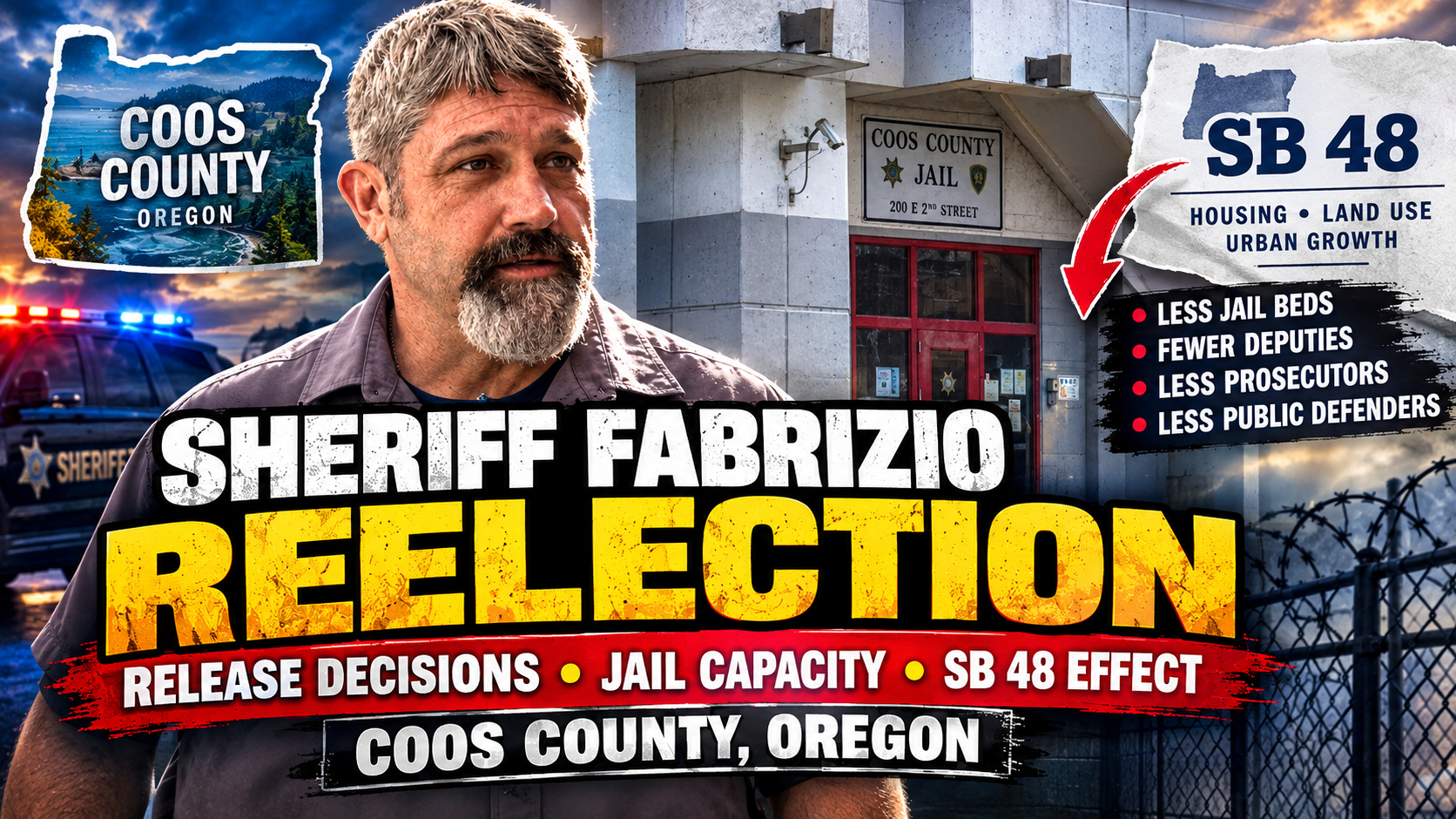
The jail is built to legally hold up to 198 inmates, but because voters have repeatedly declined to fund full operations, it is currently staffed and financed to hold only about 49. County taxpayers do not believe that this local crisis is due to a lack of funding, but to legislation designed to impose Social Justice, not Equal Justice.
The unused beds are not a sign of low crime, but failed leftist policies.
Where does that leave us?
Stepping back from the details, a larger pattern emerges. It is easy to say that Oregon lawmakers and Governor Tina Kotek have “sabotaged” the justice system because they did.
The cold, hard truth is that Oregonians are the problem with Oregon.
The majority of voters have repeatedly endorsed the political leadership and policy direction that produced this moment. Until Democrats and NAV voters are willing to demand different priorities in Salem and refuse to accept such low standards, voters in red counties are unlikely to invest in the unglamorous basics of public safety at home.
Until one or the other collapses, changes, or adapts, counties like Coos will remain trapped in the same destructive loop. Crowded jails, revolving‑door justice, and a widening gap between what the law promises and what the system can actually deliver.
Oregon’s justice system will continue to serve as a warning — not just about bad policy, but about what happens when a state refuses to align its values, its votes, and its budgets with the realities on the ground.
Related Posts:
Rep. Court Boice Requests the Resignation of Sheriff Ward for Suspected Crimes
Port Orford Said No to FLOCK Cameras. The Seven Cities of Coos County Should Say It Next.


