Port Orford Said No to FLOCK Cameras. The Seven Cities of Coos County Should Say It Next.
"GET THE FLOCK OUT OF HERE!"
On July 16, 2026, the Port Orford City Council did something rare in American government. Every member voted yes — unanimously — on a resolution prohibiting FLOCK automated license plate reader cameras inside the city.
No hedging. No study committee. No pilot program. A unanimous vote to keep mass surveillance off their streets, and to require a two-thirds supermajority of registered voters before any such technology could ever come back.
That vote deserves more than applause. It deserves imitation. Coos Bay, North Bend, Bandon, Myrtle Point, Powers, Lakeside, and Coquille each have the same authority Port Orford exercised. So does the Coos County Board of Commissioners.
Here is the case for using it.
What FLOCK Cameras Actually Do
Strip away the sales pitch and the technology is straightforward. FLOCK cameras photograph every vehicle that passes them. Every plate. Every driver. Every trip. The system builds a searchable digital record of cars using license plates, vehicle color, and other characteristics. No warrant is required. No suspicion is required.
Think carefully about what that means. You drive to church. You drive to a gun shop. You drive to a political meeting, a doctor's office, a friend's house. Every one of those trips lands in a database that a government employee can search at will. And that database does not stay local. FLOCK, an Atlanta-based company, works with over 4,600 law enforcement partners in 49 states. A camera in Coquille feeds a national system run by a private corporation.
Endless surveillance is not targeted law enforcement. It is a web of mechanized government spies built to centralize the digital record of where citizens and visitors travel, when they travel, and with whom. The authorities will claim the records are temporary and prohibited by law, knowing they are unsecured promises because of the permanence built into the internet. Those records reveal far more about a person's private life, associations, habits, and routines than any single observation ever could.
Now imagine a disgruntled enemy — someone who considers your lifestyle wrong, your beliefs dangerous, your associations suspicious — suddenly gaining access to that record. About you. About your family. The infrastructure exists before the threat does. That is the danger.
The system tracks lawful people doing lawful things. That is the product.
Continuous Unwarranted Surveillance Violates the Constitutional Framework Our Founders Built
Think of what Jefferson, Madison, or Franklin would have thought of King George having a technology as powerful as today. The ability to track your every move.
The Fourth Amendment protects Americans against unreasonable searches and seizures. Article I, Section 9 of the Oregon Constitution provides the same protection under state law. Both provisions rest on one foundational principle: government must justify itself before it intrudes on you. It shows cause. It gets a warrant. It investigates a specific suspect for a specific reason.
FLOCK inverts that principle entirely. It places every driver under constant, suspicionless monitoring. It builds a permanent record of free travel and free association, then asks citizens to trust that nobody will misuse it.
Americans have long opposed exactly this kind of expansion. The presumption of innocence is a bedrock of our legal tradition. You should not be treated as a potential suspect simply for driving down a public road. Bulk collection of movement data without individualized reasonable suspicion runs counter to the original understanding of the Fourth Amendment. It is incompatible with limited government and constitutional fidelity.
Individual autonomy is not a partisan question. Civil liberties advocates on the left and constitutional conservatives on the right agree on this fact. The disagreement sits between citizens and the surveillance industry, and the industry has the lobbying budget.
History Offers a Warning We Should Not Ignore
Nicolae Ceaușescu's Romania built one of the most comprehensive surveillance states in the history of the communist world. The Securitate secret police maintained a vast network of informants, wiretaps, and constant monitoring that tracked citizens' movements, associations, and private lives. The goal was totalitarian control — to suppress any hint of dissent before it could organize, to make every citizen aware that the state was watching, and to ensure that awareness shaped their behavior.

Modern automated license plate readers may seem far removed from the crude methods of a communist dictatorship. They are not secret police. No one is knocking on doors.
But they offer something Ceaușescu's Securitate could only dream of: a far more efficient and comprehensive technological capability to log the daily travels of every resident and visitor, automatically, continuously, and without a single human informant. The scale is incomparably larger. The cost is incomparably lower. The searchability is instant.
Allowing such systems to be deployed without the direct consent of the people risks normalizing the same logic of pervasive oversight that defined oppressive regimes — only now executed with greater precision and fewer human resources. The difference between a surveillance state and a free society has never been a matter of intent. It has always been a matter of infrastructure. Once the infrastructure exists, intentions change with administrations.
Port Orford's resolution wisely rejects this path. It chooses limited, accountable government over the quiet efficiency of mass tracking.
Oregon Cities Are Walking Away
Coos County residents are late to this debate, and that is actually good news. Other Oregon cities already ran the experiment and reported the results.
Eugene terminated its FLOCK contract in December 2025, with the police department citing "vulnerabilities and limitations" in the system. City Manager Sarah Medary said the decision "ultimately came down to trust."
Springfield ended its cameras alongside Eugene.
Woodburn suspended its cameras after residents confirmed immigration enforcement agencies had accessed local camera data dozens of times.
Bend cut ties with FLOCK in January 2026.
One detail from Eugene deserves special attention. A private company reactivated a surveillance camera without the knowledge of the police department that supposedly controlled it. When the vendor holds the switch, local control is a fiction.
Oregon's legislature responded. Governor Tina Kotek signed Senate Bill 1516, capping ALPR data retention at 30 days, barring use of the data for immigration enforcement, and giving Oregonians the right to sue private firms that misuse plate data. Salem regulated the problem. Port Orford eliminated it. Elimination is the stronger position.
The Practical Risks Are Just as Damning
There are additional liabilities every elected official in Coos County should weigh carefully.
Mission creep is not a hypothetical. Once the infrastructure exists, data can be accessed by multiple agencies and has been shared beyond local law enforcement in other jurisdictions. Local officials lose meaningful control over who ultimately handles sensitive information about their community and how it may be used in the future.
The chilling effect on liberty is real. When people know their movements are being systematically recorded and stored, it discourages free association, travel to certain locations, and participation in lawful activities. A free society depends on citizens being able to go about their business without the quiet knowledge that a digital trail is being compiled. In a small county, a movement database reveals nearly everything: who attends which church, who visits which meeting, who parks outside which business.
Data security and corporate involvement create serious exposure. These systems rely on private companies storing sensitive location data in the cloud. That introduces risks of breaches, unauthorized access, and long-term retention that go well beyond traditional law enforcement record-keeping. The decision about where your neighbors' movement data lives should not rest with a vendor in Atlanta.
Taxpayer protection matters. Avoiding vendor contracts and recurring subscription costs keeps government lean and prevents entanglement with outside technology interests whose business model depends on expanding the network, not limiting it.
A Resolution Is a Statement. An Ordinance Is the Law.
Port Orford passed a resolution, and that unanimous vote matters as a public declaration of principle. But the cities and the county need to go further. They need to pass ordinances — and the distinction is not a technicality. It is the difference between expressing an intention and enforcing one.
A resolution is a formal expression of a governing body's position or intent. It carries moral and political weight. It does not carry the force of law. No one can be penalized for violating a resolution. A future council can quietly reverse it with a simple majority vote. It is a statement, not a shield.
An ordinance is local law. It commands specific conduct, prohibits specific actions, and attaches real consequences to violations. An ordinance with a clear directive — "it shall be unlawful" — and a punishment clause that specifies fines, civil liability, and potential removal from office gives citizens legal standing to enforce the prohibition. It gives courts something to apply. It gives officials something to fear. A future administration cannot simply ignore it or quietly shelve it without facing legal exposure.
That is why Coos County cities and the Board of Commissioners must act by ordinance, not resolution. Good intentions without legal teeth invite the very future they claim to prevent. The surveillance industry is patient. Contracts get renegotiated. New administrations arrive. Without an ordinance on the books — with penalties attached and a supermajority referendum required to undo it — a resolution is just a speed bump.
The Freedom from Invasive Surveillance Ordinance
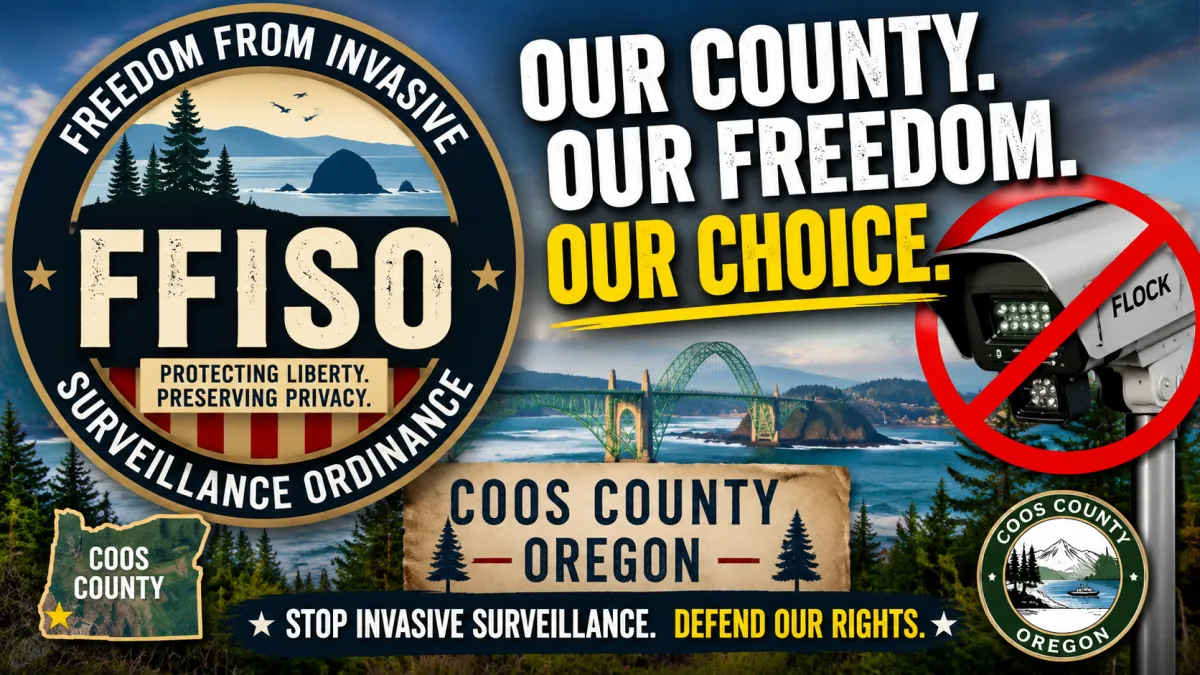
Coos County citizens are not waiting for permission. They are preparing a citizen initiative — the Freedom from Invasive Surveillance Ordinance — and it has real teeth. In summary, the ordinance:
Fully prohibits the acquisition, installation, and use of automated license plate readers by any county government agency or official.
Requires removal of any existing devices within 30 days of adoption.
Allows one narrow exception tied to a specific warrant issued by a judge for a specific suspect — preserving legitimate, targeted law enforcement while ending dragnet surveillance.
Imposes financial penalties on officials who violate the ordinance, so the prohibition carries real consequences rather than good intentions.
Requires a two-thirds supermajority citizen referendum to ever amend or repeal it.
That last provision is the most important. Surveillance programs tend to return under new names once public attention fades. This ordinance locks the door and hands the key to the voters. In the absence of a state or national constitutional amendment explicitly protecting the right to privacy, direct democracy is the most reliable mechanism available to ensure the principles that conservatives and liberals have both championed for generations are actually upheld.
What Happens Next Is Up to You
Port Orford proved that a small coastal community can act decisively where larger governments stall. The councils of Coos Bay, North Bend, Bandon, Myrtle Point, Powers, Lakeside, and Coquille now face a clear choice. So does the Coos County Board of Commissioners.
Elected officials, the path is straightforward. Put a prohibition ordinance on your next agenda — not a resolution, an ordinance, with a clear directive and a punishment clause. Vote yes on the record, so your constituents know where you stand on the warrantless tracking of their daily movements.
Citizens, here is yours:
Show up at your city council meeting and ask your council to follow Port Orford's lead — and to go further, with an ordinance that has the force of law.
Contact your county commissioners and request a countywide prohibition by ordinance.
Sign and support the citizen initiative when the Freedom from Invasive Surveillance Ordinance reaches you.
Eugene, Springfield, Woodburn, and Bend learned this lesson at their own expense. Port Orford acted before the cameras went up. Coos County has the same window right now, and windows like this close fast once contracts get signed and vendor relationships take root.
The right to travel your own county without a government log of your movements is not a technical question or a policy preference. It is a foundational American principle. Port Orford defended it. The rest of Coos County should do the same.
Full Text: Freedom from Invasive Surveillance Ordinance
ORDINANCE NO. ______
AN ORDINANCE OF THE COUNTY OF COOS, OREGON, PROHIBITING THE ACQUISITION, DEPLOYMENT, OPERATION, OR USE OF AUTOMATED LICENSE PLATE READER SYSTEMS, INCLUDING FLOCK SAFETY SYSTEMS, BY ANY GOVERNMENT AGENCY OR OFFICIAL; DECLARING SUCH SURVEILLANCE A VIOLATION OF INDIVIDUAL RIGHTS; PROVIDING PENALTIES; REQUIRING CITIZEN VOTER APPROVAL TO AMEND OR REPEAL; AND PROVIDING FOR AN EFFECTIVE DATE.
WHEREAS, the County of Coos is committed to protecting the constitutional rights, civil liberties, and fundamental privacy of all its residents, visitors, and businesses; and
WHEREAS, continuous, suspicionless collection of vehicle location, time, and identification data through Automated License Plate Reader (ALPR) systems creates a detailed record of the movements of all persons who travel by vehicle within the jurisdiction; and
WHEREAS, such mass, warrantless tracking constitutes invasive government surveillance that violates the reasonable expectation of privacy of individuals, infringes upon the right to freedom of movement and association, and is inconsistent with the protections against unreasonable searches and seizures guaranteed by the Fourth Amendment to the United States Constitution and Article I, Section 9 of the Oregon Constitution; and
WHEREAS, the Board of Commissioners of Coos County finds that the deployment of networked ALPR systems such as those provided by Flock Safety and similar vendors enables the creation of searchable databases of lawful activity by the general public and poses unacceptable risks of data misuse, unauthorized sharing, and chilling effects on free association and travel; and
WHEREAS, the Board of Commissioners of Coos County further finds that decisions affecting the fundamental privacy and daily tracking of the people should not be left solely to administrative or future legislative action, but should require direct approval by the citizenry itself;
NOW, THEREFORE, BE IT ORDAINED BY THE BOARD OF COMMISSIONERS OF COOS COUNTY, OREGON, AS FOLLOWS:
Section 1. Definitions.
For purposes of this Ordinance:
(a) "Automated License Plate Reader system" or "ALPR system" means any system of one or more cameras, sensors, or devices, combined with computer software, algorithms, or databases, that captures images of license plates or vehicle characteristics and converts them into computer-readable data, including location, date, time, and vehicle descriptors. This includes, without limitation, systems marketed or provided by Flock Safety, Axon, Motorola Solutions, or any similar vendor.
(b) "Government agency" means any department, office, board, commission, police department, sheriff's office, or other entity of Coos County, or any official, employee, agent, or contractor acting on its behalf.
(c) "Official" means any elected or appointed officer, employee, agent, or contractor of a government agency.
Section 2. Prohibition - Clear Directive.
(a) It shall be unlawful for any government agency or official of Coos County to acquire, lease, purchase, install, operate, maintain, access, share data from, or otherwise use any ALPR system within the jurisdictional boundaries of Coos County.
(b) No public funds of Coos County shall be expended for any ALPR system or related services.
(c) Any existing contract, agreement, or arrangement for ALPR systems shall be terminated as soon as legally permissible, and all devices shall be deactivated and removed within thirty (30) days of the effective date of this Ordinance.
(d) This prohibition applies to fixed, mobile, and portable systems and to any data previously collected by such systems under the control of a government agency.
Section 3. Limited Exception.
Nothing in this Ordinance shall prohibit the use of a camera or sensor system solely for a specific, court-authorized investigation of a particular individual or vehicle pursuant to a valid search warrant or court order, provided that the system does not continuously collect data on the general public and that all data unrelated to the authorized investigation is immediately deleted.
Section 4. Declaration of Rights Violation.
The Board of Commissioners of Coos County hereby declares that the acquisition, deployment, or use of ALPR systems for the continuous, suspicionless monitoring of vehicle movements constitutes invasive government surveillance of the people and is a violation of the individual right to be free from unreasonable searches and seizures and from unwarranted government intrusion into lawful travel and association.
Section 5. Punishment for Violations by Officials and Government Agencies.
(a) Any official of a government agency who knowingly violates, or directs, authorizes, or permits a violation of, Section 2 of this Ordinance shall be guilty of a Class A violation pursuant to ORS 203.065 and, upon conviction, shall be punished by a fine of not less than Five Hundred Dollars ($500) nor more than Two Thousand Dollars ($2,000), as authorized under ORS 153.018.
(b) Any government agency that violates, or whose officials, employees, agents, or contractors violate, Section 2 of this Ordinance shall be guilty of a Class A violation pursuant to ORS 203.065 and, upon conviction, shall be punished by a fine of not less than One Thousand Dollars ($1,000) nor more than Four Thousand Dollars ($4,000), as authorized under ORS 153.018 for corporations.
(c) Each day that a violation continues shall constitute a separate offense.
(d) In addition to the penalties provided herein, any official who violates this Ordinance may be subject to disciplinary action, including suspension or removal from office or employment, in accordance with applicable personnel rules or law.
(e) Any person aggrieved by a violation of this Ordinance may bring a civil action against the responsible official and/or government agency for injunctive relief, actual damages, and reasonable attorney's fees.
Section 6. Amendment or Repeal - Mandatory Citizen Referendum and Supermajority Requirement.
(a) This Ordinance shall not be repealed, amended, suspended, weakened, or otherwise modified in any manner that would authorize, permit, or facilitate the acquisition, deployment, operation, or use of any ALPR system unless the proposed change is first referred to the registered voters of Coos County at a regular election.
(b) Any such measure shall require the affirmative vote of at least two-thirds (66.7 percent) of the votes cast on the question in order to become effective.
(c) No contract, pilot program, or operational use of any ALPR system shall be entered into or authorized unless and until the requirements of this Section have been fully satisfied.
Section 7. Severability.
If any provision of this Ordinance is held invalid or unenforceable, the remaining provisions shall continue in full force and effect.
Section 8. Effective Date.
This Ordinance shall take effect immediately upon adoption and publication as required by law.


