Fact-Check: Oregon's $32.8M Consumer Recovery Claim
Politics, Consumer Protection, Fact Check
Fact-Checking Oregon’s $32.8 Million Consumer Recovery Claim
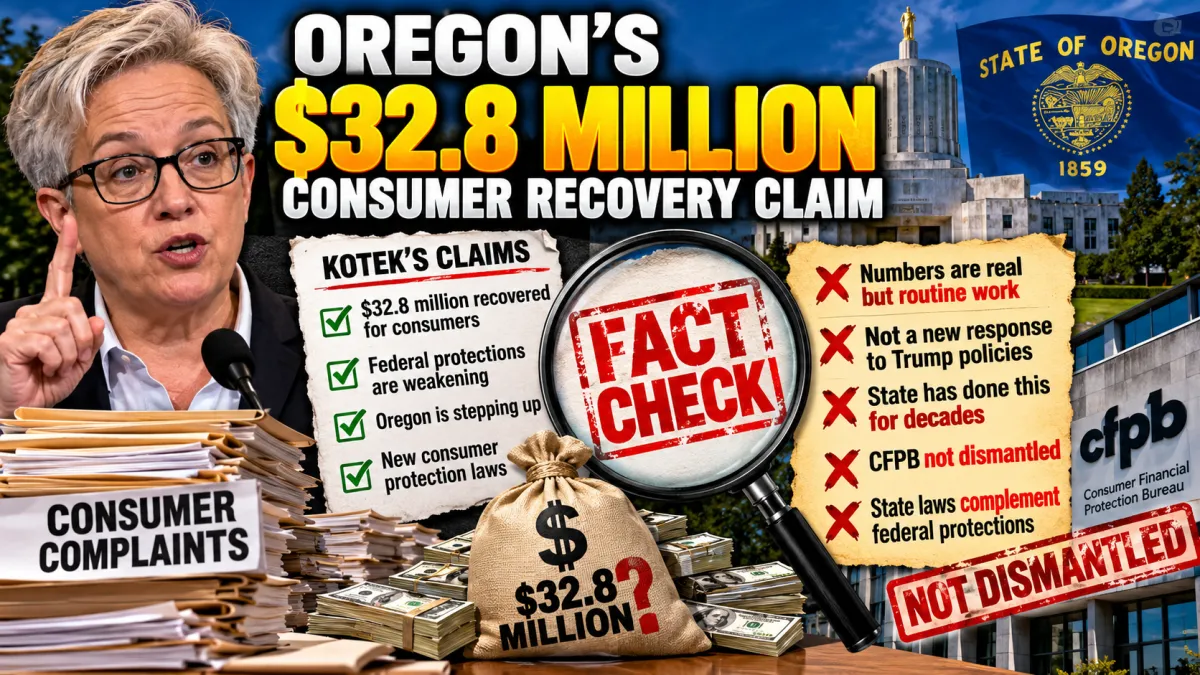
Oregon Governor Tina Kotek’s October 8, 2026 press release touts tens of millions recovered for consumers as federal protections “weaken.” The numbers are real, but the framing around the federal Consumer Financial Protection Bureau (CFPB) deserves a closer, more nuanced look.
Link to the Press Release: https://web.govpress.oregon.gov/mail/util.cfm?gpiv=2100170351.7034.421&gen=1
What the October 8 Press Release Actually Claims
The release, titled “Oregon Recovers $32.8 Million for Consumers as Federal Protections Weakened”, centers on a headline figure: more than $32.8 million recovered for Oregonians since January 2023 by the state’s Division of Financial Regulation (DFR). These dollars come from insurance companies, lenders, and other financial institutions that allegedly denied claims, overcharged customers, or otherwise violated obligations (gorgenewscenter.com).
Governor Kotek notes that in the first half of 2026 alone, DFR advocates recovered nearly $4 million through complaint handling and negotiations. The press release emphasizes that these cases are often complex and that state advocates help consumers secure refunds, claim approvals, or other relief they might not win on their own.
Are the Recovery Numbers Accurate?
On their face, the $32.8 million and $4 million figures are plausible and consistent with typical state insurance and financial regulation work. State divisions like DFR routinely track:
claim payments obtained after wrongful denials,
premium refunds and billing corrections, and
restitution ordered in enforcement actions—yet the governor’s messaging uses these routine functions as another opportunity to blur her own record by shifting focus and blame toward the Trump administration instead of owning the long‑standing state role.
The press release cites DFR’s internal case records as its source, a standard practice in regulatory reporting. There is no clear evidence that the dollar amounts themselves are inflated or fabricated. If anything, they likely aggregate many relatively small, individual consumer wins into a single, attention‑grabbing total.
📌 Key Takeaway: The recovery figures appear broadly credible, but they represent routine regulatory work over several years, not a sudden surge driven by federal policy changes.
A Longstanding State Role, Not a New Response to Trump-Era Policies
The framing becomes overstated when it suggests these recoveries are primarily a response to the “dismantling” of the CFPB under the Trump administration. The release quotes Oregon Consumer Justice’s Lisa Watson as saying, “As federal consumer protections are being dismantled, Oregon is stepping up and building a stronger foundation of consumer protections” (gorgenewscenter.com).
In reality, state insurance and financial regulators have been doing this kind of recovery work for decades, long before the CFPB was created in 2010 and long before the Trump administration. Most of the processes DFR uses today—investigating complaints, pressuring insurers to honor policies, and enforcing state law—continue longstanding state authority, not a brand‑new backstop built in response to Washington, D.C.

-toned photo of two consumer advocates reviewing complaint files and spreadsheets in a modest...
Most dollars recovered come from traditional insurance complaint handling, not from replacing federal agencies.
The CFPB Funding Fight: Important, But Separate
The press release nods to a real and high‑stakes legal battle over CFPB funding. In New York et al. v. Vought, a coalition of states (including Oregon) challenged Acting CFPB Director Russell Vought’s decision not to request funds from the Federal Reserve. On September 25, 2026, a federal court in Oregon ruled that decision unlawful, vacated it, and held that the Federal Reserve must transfer the CFPB’s reasonably necessary funding based on its gross earnings (law.justia.com).
This ruling followed earlier defeats for the Trump administration’s defunding strategy in Washington, D.C., and California, where judges held that the White House could not simply cut off CFPB funding even when the Federal Reserve reported losses (apnews.com). By late 2026, courts had largely restored the CFPB’s funding pipeline and reaffirmed its independence.
That context matters: the CFPB has not been “dismantled” so much as contested in court and then reaffirmed. Oregon’s role in the litigation is significant, but it is separate from DFR’s day‑to‑day work resolving insurance complaints and recovering money for residents.
Legislative Bills: Strengthening, Not Replacing, Consumer Protection
The press release also points to consumer‑focused legislation passed in recent sessions. While the statement does not list every bill in detail, measures backed by the governor and DFR have generally aimed to:
tighten oversight of insurance practices and rate filings,
clarify consumer rights in lending and debt collection, and
expand enforcement tools and penalties for repeat violators.
These bills do meaningfully enhance Oregon’s toolkit. But they do not turn DFR into a state‑level CFPB. The federal bureau still oversees national banks, large mortgage servicers, and complex financial products that many state regulators can't reach directly. Oregon’s laws are best understood as complements to federal protections, not a full substitute.
State-Driven Insurance Work, Not a One-for-One Federal Replacement
The recovery story is relatively straightforward: Oregonians file complaints about health, auto, homeowners, or life insurance claims, or about loans and other financial products. DFR reviews the case, contacts the company, and uses state law and regulatory pressure to get money owed to consumers. That is traditional insurance complaint handling—important, labor‑intensive, and often under‑appreciated, but hardly new.
Framing these recoveries as a direct response to the CFPB’s supposed dismantling blurs that reality. The bulk of the work would have occurred with or without the federal funding fight. Moreover, because many of Oregon’s consumer protection systems predate both the CFPB and the Trump administration, it is misleading to imply that state agencies suddenly “stepped up” only once Washington faltered.
A Nuanced Bottom Line
Governor Kotek’s October 8, 2026 announcement accurately highlights substantial consumer recoveries and real legislative efforts. The dollar amounts align with standard regulatory practice, and Oregon has played a meaningful role in defending the CFPB’s funding structure in court. Those are legitimate achievements.
At the same time, the claim that these recoveries primarily respond to the “dismantling” of federal protections is politically framed and somewhat overstated. Most of the work described is state‑driven, long‑standing insurance and financial complaint handling, not a one‑for‑one replacement for the CFPB. After a series of court victories, the federal bureau remains funded and active. Oregon’s efforts are best seen as part of a layered system in which state and federal protections operate together to keep more money in consumers’ pockets.
RELATED POSTS:


