The Framework That Couldn't Hold: Fifteen Years Later, I'm Still Searching for Answers
In 2011, I wrote a letter to the editor proposing something unusual in conservative politics: a value hierarchy that placed life above liberty. Not as religious doctrine, but as a philosophical necessity.
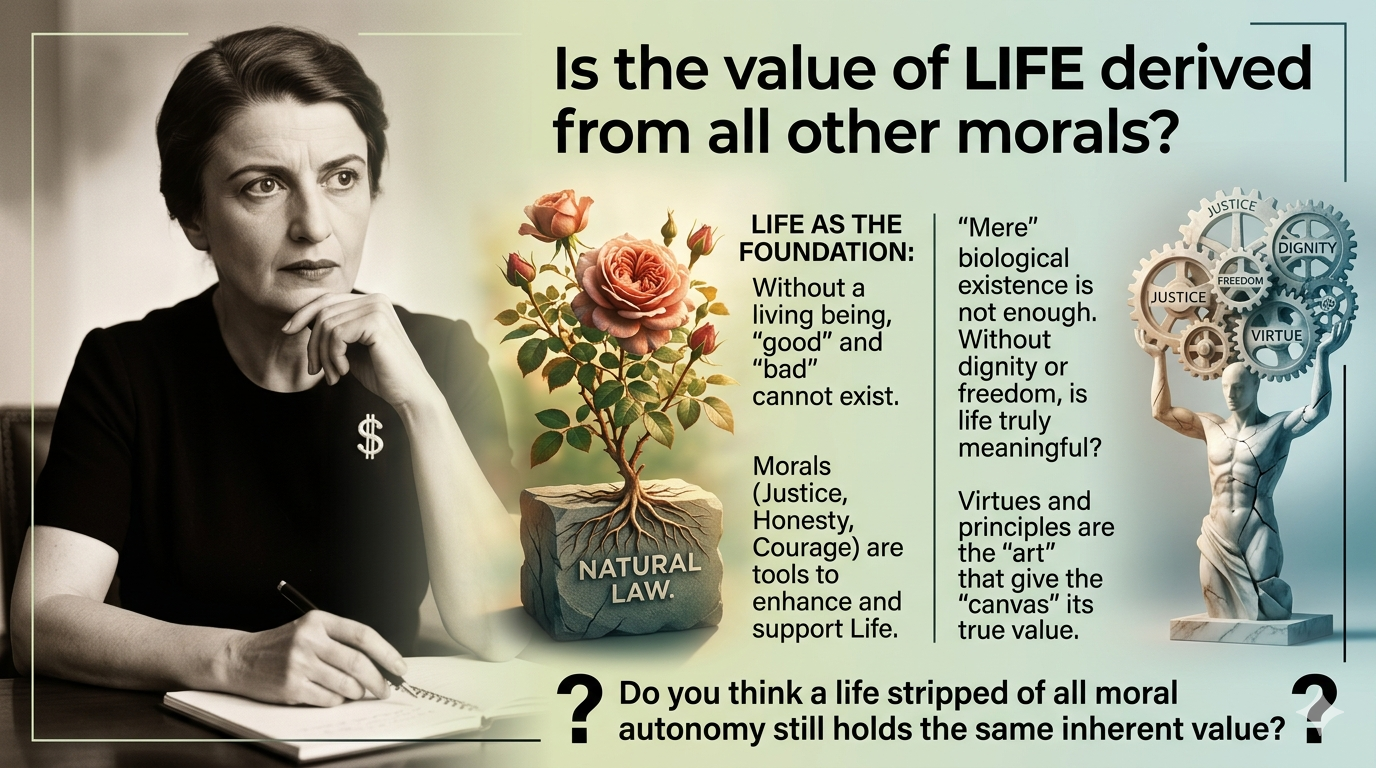
My reasoning was grounded in objectivism: without a living being to observe and assess reality, concepts of good and bad cannot exist.
The logic was rational, not emotional. No observer, no moral universe. Life becomes the prerequisite for everything else—including the liberty and pursuit of happiness that typically dominate conservative rhetoric. It is not the fear of death that drives the framework. It is reason recognizing that consciousness is the foundation of all value judgments.
This framework led me to positions that split partisan lines. Opposition to both the death penalty and abortion. Critique of military interventionism and the Drug War. Support for constitutional constraint over executive expansion.
I invited readers to "extrapolate" how subsequent events would test these principles.
Thirteen years later, my answer is complicated.
When the Tea Party Still Had Momentum
The 2011 context matters. The Tea Party had just delivered a shellacking in the 2010 midterms, gaining 63 House seats on promises of fiscal responsibility and adherence to the US Constitution.
But by November 2011, public support had already begun falling, even in Tea Party strongholds. The opposition perceived the movement as too extreme and unwilling to compromise.
My distinction in that letter between "limited government" and "anti-government" positions proved prescient. What started as constitutional conservatism would eventually morph into something different entirely.
I identified with Ron Paul's approach—Jeffersonian skepticism of foreign entanglements, strict constitutional interpretation, and opposition to the Federal Reserve. This represented one faction within the broader Tea Party coalition.
The other faction, what analyst Walter Russell Mead called "Palinites," favored more aggressive responses to maintain American primacy abroad.
That tension never resolved. It intensified. The Trump Administration chose people who would take the offensive in certain situations. Politically and militarily.
Why I Reversed My Position on the Death Penalty
My original framework opposed capital punishment on life-first grounds. The government has executed innocent people—a violation of the supreme value I placed on life.
The data supports this concern. At least 4.1% of death row defendants are likely innocent. Since 1973, 202 people have been exonerated from death row after spending an average of 11.5 years imprisoned for crimes they didn't commit.
For every 8.3 executions carried out in the U.S., one wrongfully convicted prisoner is released from death row.
But my position shifted. Not because the data changed, but because the threat environment did.
I came to believe that life must be protected, and in an imperfect world, there are no guarantees that soft-on-crime policies will not release these criminals back into society, only to commit more murders.
The adaptation was tactical, not philosophical. My principle—protect innocent life—remained constant. The application reversed.
I concluded that the only way to protect innocent life might be ending the life of those who have committed the most heinous crimes before liberal politicians release them.
This represents a fundamental reordering of my own framework. The logic that once opposed state-sanctioned killing now endorses it as necessary protection against institutional failure.
The Drug War Prediction That Came True
In my 2011 letter, I warned about "unintentional collateral damage" from drug prohibition—harm to families and communities that exceeded the direct violence of drug use itself.
This prediction proved accurate.
Research shows that children who experienced paternal incarceration at age 5 demonstrated significantly more rule-breaking behaviors at age 15. Nearly half of the 1.25 million people in state prisons are parents of minor children.
The non-budgetary social costs of incarceration are estimated at $83.2 billion annually.
Almost half of all young adults ages 18-49 have an immediate family member who has been imprisoned. For African American families, the rate exceeds 60%.
Children of incarcerated parents face increased risks for PTSD, anxiety, asthma, ADHD, behavioral problems, developmental delays, learning disabilities, and delinquency.
The cocaine/crack epidemic was a product of psyops programs for secret missions inside other countries, like the Middle East and Central America. The globalists and the communists saw the poor innercity people as disposable chattel. It was to eliminate the undesirables while fueling the war machine.
My framework identified this generational destruction before it became a mainstream conversation. By 2015-2020, criminal justice reform had entered the political center.
But I see no vindication in that shift.
There was no overcorrection, in my view. There was a chasm between those who wanted a limited government and those who worshiped collectivism.
From my perspective, the reform movement wasn't addressing the problems I had identified. It was pursuing different objectives entirely.
Instead of curtailing drug use through mental health means and social stigma, the government encouraged it and even supplied the paraphernalia to use the drugs. Then liberal cities with soft-on-crime policies allowed drug-addled derelicts to commit billions of dollars in property crimes and theft.
It was a battle between those who cherished life and liberty over those who were willing to sacrifice their fellow citizens for the overthrow of our Constitutional Republic.
The Military-Industrial Complex Holds
In my 2011 letter, I described the "military-industrial complex calling itself democracy"—a critique of how institutional incentives corrupt stated missions.
The subsequent decade validated this concern.
The top five weapons companies received $2.02 trillion in contracts between 2001 and 2021. They spent over $1 billion on lobbying during the Afghanistan war alone.
U.S. wars in Afghanistan, Iraq, and Syria have cost American taxpayers $6.4 trillion since 2001.
Eight generals who commanded American forces in Afghanistan between 2008 and 2018 now serve on more than 20 corporate boards.
In the first 10 days of the Libyan war in 2011, the administration spent roughly $550 million, with $340 million for munitions that had to be replaced.
The pattern the framework predicted—perpetual war representing perpetual profits for business and government interests—continued across administrations and party control.
Even where military force is used, it's limited, and there has been no nation-building.
But institutional incentives are still driving foreign policy. The structure remains intact.
COVID as the Breaking Point
The framework's most significant stress test came from an unexpected source.
Yes, under COVID, the rules changed. It proved the media was lying to the people, the government was taking too much authority, and the communists saw their chance to overthrow the government.
This marked my shift from theoretical principles to survival mode. The limited government framework I championed in 2011 now confronted a different calculation.
All levels of government expanded authority during the pandemic. Governors imposed mandates. Federal agencies issued directives. Trump defended Operation Warp Speed while critics questioned the use of emergency powers.
They all took advantage of the crisis.
Even Trump, who I believe understands these foreign and domestic threats like no other politician, was bamboozled by some of the health authorities working against him.
This acknowledgment is significant for me. If institutional incentives are powerful enough to mislead even a president I trust, what prevents those same forces from capturing the expanded executive authority I now see as necessary?
Ironically, the only entity that can rein in the executive branch's overpowering authority is the Legislative Branch, but it is currently impotent.
The Tea Party Cycle of Broken Promises
What happened between 2011's Tea Party ascendancy and today's congressional impotence? The answer frustrates me.
Simple: they did not keep their promises, and then the voters reelected them, rewarding them for their failure and thereby ensuring that the cycle continues.
This assessment is darker than institutional capture. It suggests democratic accountability itself has broken down.
The data support the disillusionment. Despite initial electoral success, Tea Party-backed candidates won only 32% of races in 2010. By 2012, the movement suffered what observers called "total defeat" with prominent candidates failing.
The 2013 government shutdown led by Tea Party favorite Ted Cruz failed to gain Republicans anything but public scorn. House Speaker John Boehner said in December 2013 that conservative groups aligned with the Tea Party had "lost all credibility."
But voters kept re-electing the politicians who failed to deliver on Tea Party promises. This reality still frustrates me.
This created the vacuum that concentrated executive power now fills.
From my framework's perspective, the solution requires more people who believe in Ron Paul's type of conservatism serving in the House and the Senate, so there is no need for a more powerful executive office.
But I recognize this creates a circular problem. You can't get the legislative constraint without first using executive power to break institutional capture. Using that power creates the precedent for "the wrong person" later.
Adapt or Die
Looking back at my framework's evolution from 2011 to today reveals a consistent pattern.
My principle—life as the prerequisite for all other values—remained constant. The applications shifted dramatically based on my threat assessment.
From opposing the death penalty to supporting it as protection against failed criminal justice policies.
From limited government principles to accepting concentrated executive power as necessary during what I see as a color revolution.
From constitutional constraint to trusting presidential judgment in an existential crisis.
The principle stayed constant, but the threat environment changed so dramatically that different tactics became necessary. Adapt or die.
This operational logic bridges my philosophical consistency with tactical reversals.
But it raises the central tension in my framework. If the threat environment can justify these adaptations, what's the limiting principle?
At what point does "adapt or die" become indistinguishable from "the ends justify the means"—the collectivist logic I'm fighting against?
How do I know when I've adapted versus when I've abandoned my framework?
Now that is a good question. I think the country will eventually find the answer.
What Keeps Me Up at Night
My honest acknowledgment—that I don't have the answer yet—reveals the current state of my framework.
It's no longer a predictive model or a stable set of principles. It's a live experiment in whether philosophical consistency can survive contact with what I perceive as an existential threat.
My worry isn't abstract.
My fears are watching my children and grandchildren suffering under the tyranny we fought against. The failure of the apathetic American people.
The framework I created, which began with life as the supreme value, ends with concern for the next generation's freedom.
The tools being built to protect life today—concentrated executive authority, my acceptance of state-sanctioned killing, suspension of limited government principles—could become the instruments of tyranny tomorrow.
Science states that the world was created by turbulence, havoc, and chaos that ruled its existence. Humans are the only ones who can create a just refuge for a civil society, but only if we allow it.
This is my framework's final position. Not certainty, but contingency. Not prediction, but adaptation. Not answers, but the acknowledgment that the country will eventually find them.
Whether those answers validate my 2011 principles or expose their inadequacy remains to be seen.
My framework couldn't hold in its original form. The question is whether its adaptation represents philosophical evolution or philosophical collapse.
I'm watching, like the rest of you, to find out.
Sincerely, Rob Taylor


