
Public Money, Private Hands: Who Really Benefits From Urban Renewal Money in Coos Bay
Between December 2025 and January 2026, the Coos Bay Urban Renewal Agency Board voted twice to award $150,000 in public money to entities connected to a single property investor — Simon Alonzo Jr. — who chairs the Bay Area Hospital District Board, sits on the board of Oregon Coast Community Action (ORCCA), presides over a nonprofit called Compass Outreach, and controls many businesses in the region. On the first grant, city staff recommended $25,000. The board approved six times that amount, emptying the Empire Improvement Program's entire available balance. Three weeks later, the same board approved a second $150,000 grant to another Alonzo-connected entity on the same street.
No one has publicly explained either override of the standard limit.
Urban Renewal and TIF are Public Money
Tax Increment Financing is the taxing process Urban Renewal Agencies use to capture growth from property-tax revenue within a designated urban renewal district to fund improvements and revitalization. Coos Bay operates two districts: Downtown and Empire. The city has described TIF as not taxpayer-funded. They correctly claim it does not create a tax, but they fail to mention that it creates debt that overlapping taxing districts must pay with property taxes. Those overlapping taxing districts are mostly countywide districts, which means every property owner in the county is responsible for the city’s UR debt. Schools, fire protection, and county services forgo a portion of their permanent tax rate so the urban renewal agency can spend it. It is absolutely public money — and in Coos Bay, a good portion of it went to one man's companies twice in three weeks.
Grant One: 1155 & 1165 Newmark Avenue
On November 25, 2025, an entity named 1155 Newmark Holdings, LLC — or Simon Alonzo — applied for a grant covering parking lot reconstruction, siding, windows, ADA upgrades, LED lighting, and signage at 1155 and 1165 Newmark Avenue. Stated project cost: $295,000. The application lists the business as one year old and the contact email as [email protected] — the Primal Investments Inc. domain — even though the named applicant is 1155 Newmark Holdings, LLC. The city's own staff report, prepared by Executive Coordinator Christine Sylvester and routed through Rutherford as Agency Manager, identifies the applicant not as 1155 Newmark Holdings, LLC but simply as "Primal Investments" — a third name for the same entity. Simon Alonzo signed both the applicant certification and the property owner certification on the same date. The staff report's action requested was explicit: approve up to $25,000, the program maximum. The board approved $150,000 — six times that amount — at the December 16, 2025 meeting. The Empire Improvement Program's FY 2025/2026 budget was $175,000. This was the second request of the fiscal year, meaning the first had already drawn $25,000. The board's vote consumed the remaining balance of exactly $150,000 in one motion, leaving nothing for any other applicant with six months left in the fiscal year.
The Coos County Assessor's records add a fourth entity name to the pile — and the Oregon SOS filing resolves it. Both 1155 Newmark Ave (account 345401) and 1165 Newmark Ave (account 345400) are owned and assessed under 1155 Empire Holdings LLC — Registry No. 2473555-97, formed September 30, 2025, five weeks before the grant application, with Primal Investments Inc. as sole member and registered agent, and Alonzo, Villegas, and Kelsey Mulkey all listed as managers at 1611 Virginia Ave Suite 219, North Bend. Both parcels transferred from Claridale LLC to 1155 Empire Holdings LLC under a single warranty deed (Document No. 2025-6772), recorded October 6, 2025, for $230,000, as confirmed by the Sales History tab for both accounts at the Coos County Assessor. The county records the sale date as September 6, 2025; the deed was recorded October 6, 2025. That recording date closes the address gap that appeared in earlier records: both parcels transferred under the same document, the same transaction, the same $230,000. The 1155 address was not missing from the sale — it was present in the county's own account record all along. Public records now confirm the six-day window between formation and closing: 1155 Empire Holdings LLC was formed September 30; the deed was recorded October 6. The LLC was created specifically to receive this property. AmeriTitle in Salem, not a local Coos Bay title company, returned the deed. Claridale LLC had paid $591,400 for the same two parcels in 2004. The combined 2026 assessed value of both properties is $940,740 — Alonzo's LLC paid roughly 24 cents on the dollar of assessed value. Public records now document the full ownership chain for 1155 Newmark: James Redburn to James and Maxine Redburn (1993, no consideration), Maxine Redburn to Claridale LLC ($591,400, 2004), Claridale LLC to 1155 Empire Holdings LLC ($230,000, 2025). The grant application was submitted seven weeks after the deed was recorded.
The application's supporting bids raise a separate question. The program requires three written bids. The staff report acknowledges only two were obtained
— one bidder declined
— yet raises no objection to moving forward. The two bids on file are from Knife River Materials ($120,825 for parking lot work) and Herzog Custom Homes ($78,105 for windows and doors, $161,157 for exterior facade, and $42,466 for concrete walkways). Those four line items total $402,553
— significantly more than the $295,000 stated project cost. The Knife River quote is dated August 4, 2025
— nearly four months before the November 25 application
— and addresses the property as "1155/1156 Newmark Ave.," the same address error that appears in the city's own staff report attachment, which lists the addresses as 1155 and 1156 Newmark rather than 1155 and 1165. The striping instructions in that same Knife River quote reference "Freedom Laundry" by name. Oregon Secretary of State records confirm that Freedom Laundry LLC lists 1155 Newmark Ave Suite A as its official principal place of business
— and that the LLC was administratively dissolved in December 2023 and reinstated on October 1, 2025, six weeks before Alonzo submitted the grant application for the same building. None of these discrepancies appear in the staff report or the meeting discussion.
The application's own project narrative also confirms in writing what Alonzo stated verbally at the December 16 meeting. Under "Financial Request," the narrative states: "we are in the process of submitting a second application for the acquisition and rehabilitation of 1200 Newmark, another severely blighted property in the district." The board had that application in hand — or had been told about it directly — before voting to approve the first $150,000.
The meeting video is public. Zero residents submitted public comment before the vote. At that same meeting, Alonzo told the board: "you will see another application for another building that our company is bringing in." The board heard it, praised his commitment to Empire, and approved the full $150,000. Mayor Benetti said on camera: "I definitely support this." Board Chair Kilmer told Alonzo: "Thank you for your investment in Empire."No board member raised a conflict-of-interest question. No recusal was noted. After the vote, Rutherford told the board she had already connected Alonzo with the Englewood development group — on the same day as the vote.
On August 30, 2026, a written inquiry to Rutherford asked whether staff had verified the legal existence of 1155 Newmark Holdings LLC and 1200 Newmark Holdings LLC before recommending approval. Her response: "I think we had a clerical error, at some point, because both are listed with the Secretary of State" — and she provided direct links to 1155 Empire Holdings LLC and 1200 Empire Holdings LLC. Both entities are directly searchable by name in the Oregon SOS registry and return results. The clerical error, as Rutherford describes it, is that the names on the applications — 1155 Newmark Holdings LLC and 1200 Newmark Holdings LLC — do not match the registered entity names. That answer raises more questions than it resolves. Simon Alonzo signed and dated both applications himself — the entity names are his own. City staff confirmed they processed the applications as submitted without independently verifying the business names. If a clerical error occurred, the record shows it originated on the applications, not at City Hall. The city approved $300,000 in public funds to applicants whose names do not match any registered Oregon business entity, and the explanation offered is a clerical error with no further elaboration.
December 16, 2025 URA Meeting (Granicus): coosbay.granicus.com — clip 750
YouTube: Dec 16, 2025 URA Meeting (~11:13)
Staff Report — 1155 & 1165 Newmark: Staff Report PDF(Note: city attachment incorrectly lists addresses as 1155 & 1156 Newmark.)
December 16, 2025 Meeting Minutes: coosbay.granicus.com — MinutesViewer
Grant Two: 1200 Newmark Avenue
On December 12, 2025 — four days before the first vote — an application was submitted for 1200 Newmark Avenue. The application lists the applicant as "1200 Newmark Holdings, LLC - Simon Alonzo" and the business name as Primal Property Management, LLC. A search of the Oregon Secretary of State business registry for "1200 Newmark Holdings, LLC" returns no results — active, inactive, or dissolved. The correct registered entity, confirmed by Rutherford's written response and verified in the SOS registry, is 1200 Empire Holdings LLC — a different name from what appears on the application. The named applicant on both grant applications — totaling $300,000 in public funds — does not match any registered Oregon business entity.
The Coos County Assessor's record for account 340400 confirms the property is owned by 1200 Empire Holdings LLC, PO Box 653, North Bend — purchased for $450,000 with a sale date of December 31, 2025, and deed reference 2026-27. The 2026 assessed value is $758,600. Alonzo paid roughly 59 cents on the dollar of the assessed value. The sale closed nineteen days after the application was submitted and six days before the January 6 vote. The assessor's name ledger reveals who sold it: The Nancy Devereux Center, Inc. — which is Compass Outreach, the public benefit nonprofit where Alonzo serves as President. Alonzo applied for a public grant for a building he did not yet own, which a nonprofit he presides over was selling to his LLC. The property was tax-exempt while Compass Outreach held it. The 2026 assessor notation confirms it converted from exempt to taxable after the sale to 1200 Empire Holdings LLC. The ownership chain on the county record runs from People's Store, Inc. to The Nancy Devereux Center, Inc. to Compass Outreach — all the same entity, all the same building — sold to Alonzo's LLC on the last day of 2025.
Oregon Secretary of State records confirm that Primal Property Management LLC — the business name listed on the application — is wholly owned and controlled by Primal Investments Inc., listed as both sole member and registered agent, with Alonzo and Villegas as managers. The full December 2025 sequence documented in public filings: December 1, Primal Investments Inc. files an amended annual report; December 8, 1200 Empire Holdings LLC is formed; December 12, the 1200 Newmark grant application is submitted, and APM Coos Bay LLC is formed on the same day; December 16, the first $150,000 grant is approved; December 31, the sale from Compass Outreach to 1200 Empire Holdings LLC closes. Four entity-level actions and one property sale in 30 days, all surrounding the grant votes. Stated project cost: $750,000. Grant awarded January 6, 2026: $150,000.
Three specific details in the application itself deserve attention. First, Alonzo checked his applicant status as "Other — Closing in progress." He did not yet own the property when he submitted the application. Second, the property owner certification — the section requiring a property owner's signature authorizing the application — is blank. No signature, no date. The sale had not closed. Third, the proposed start date for the project is listed as December 15, 2025 — three days after the application was submitted and more than three weeks before the January 6 vote. Then, on December 19, 2025 — still before the vote — 1200 Newmark Holdings, LLC submitted four invoices (nos. 3255, 3257, 3258, 3259) totaling $134,850 for improvement work at 1200 Newmark. The grant had not been approved. Those four invoices are listed as official attachments in the January 6 staff report — meaning the board voted with them in front of them and approved anyway.
The January 6 staff report, again prepared by Christine Sylvester and routed through Rutherford, identifies the applicant as "Primal Investments" — not 1200 Newmark Holdings, LLC or Primal Property Management, LLC, the names on the application itself. Unlike Grant One, where staff recommended the $25,000 maximum and the board overrode it to $150,000, staff recommended the full $150,000 directly this time. The compliance picture was also worse: the program requires three written bids. Grant One had two. Grant Two had only one — a second bidder did not respond. The staff report notes that parking lot lighting was planned but excluded from the bid entirely because requests for bids were unsuccessful. The budget line cited is "an existing urban renewal funding source" — no specific fund named, no balance stated, unlike the explicit accounting in the December report.
Rutherford's written response to the pre-ownership question was: "Generally, we would not reimburse grant funds unless the individual/business owns the building or has given us a letter from the owner acknowledging their agreement to have the building improvements done." The word "generally" is doing significant work in that sentence. No letter from the property owner appears in any public document reviewed for this article. The grant was approved anyway. On the entity name question, Rutherford attributed the mismatch to a clerical error — but Alonzo signed both applications himself, and city staff confirmed they processed the application as received without independently verifying the business name. The question of where the error originated, and whether the program's own intake process requires name verification, has not been publicly answered.
By August 2026, the 1200 Newmark situation had shifted entirely. The city held a URA Board meeting on August 18, 2026, at 7:00 PM, confirmed on the city's official meeting calendar. Rutherford wrote and signed the staff report as both City Manager and Agency Manager—the same person in both roles on the same document. According to that report, no grant funds have been disbursed, and the project never moved forward. The stated reason: after the acquisition, the former owner and tenant were given additional time to relocate, delaying planned improvements.
Alonzo now wants to sell 1200 Newmark to Friends of Coos County Animals (FOCCAS), a nonprofit seeking a permanent location for a low-cost spay/neuter and vaccination clinic. Oregon SOS filings confirm that FOCCAS's registered agent is Kelsey Mulkey, who is also listed as a manager of 1155 Empire Holdings LLC, the entity that holds Grant One's property. FOCCAS's principal place of business is 1611 Virginia Ave, North Bend, OR 97459, the same address as Primal Investments Inc. and every confirmed Primal-connected entity. The staff report is precise on one point: no grant transfer is being requested. Instead, Alonzo would relinquish the existing $150,000 award entirely, and FOCCAS would submit a brand-new grant application after purchasing the property. The August 18 meeting was discussion only, no action requested, no vote taken. Whether FOCCAS ultimately applies, and whether the board would approve a third award connected to the same property and the same address network, remains an open question. What is not open: a $150,000 grant was approved in January 2026 for improvements that never happened, on a property the applicant did not yet own when he applied, supported by invoices submitted before the vote, and the prospective buyer's registered agent manages the other grant property and shares a business address with the grant recipient.
Staff Report — 1200 Newmark Avenue: Staff Report PDF
The Wider Network
These grants do not stand alone. Three separate transactions involve the same small cluster of people — and together they tell a bigger story.
First, Compass Outreach and the 1200 Newmark sale. The Coos County Assessor's record confirms that The Nancy Devereux Center, Inc. — the former name of Compass Outreach — owned 1200 Newmark Avenue from at least 1988 until December 31, 2025. Alonzo serves as President of Compass Outreach. On December 31, 2025, Compass Outreach sold 1200 Newmark to 1200 Empire Holdings LLC — Alonzo's own company — for $450,000. The building's 2026 assessed value is $758,600. The property was tax-exempt while the nonprofit held it; it became taxable the moment Alonzo's LLC took title. Alonzo applied for a $150,000 public grant on December 12, 2025 — nineteen days before the sale closed — for a building his nonprofit still owned, leaving the property owner certification blank because the transaction had not yet settled. The URA board approved the grant six days after the sale closed, without any public discussion of the buyer-seller relationship between Alonzo and his own nonprofit.
Second, ORCCA and the 1055 Anderson sale. The Coos County Assessor's record (account 7133603) confirms that ORCCA sold 1055 W Anderson Avenue on June 12, 2025, for $1,300,000 to Parkwest Apartments LLC — a company whose sole member and registered agent is Primal Investments Inc., confirmed by the Oregon Secretary of State. Parkwest Apartments LLC was formed June 10, 2025 — two days before the sale closed. The LLC was created specifically to receive that property. The principal place of business is 1611 Virginia Ave Suite 219, North Bend — the same address as Primal Investments Inc. The mailing address is PO Box 653, North Bend — the same PO Box on every confirmed Primal-connected entity in this investigation. The property's 2026 assessed value is $1,491,340. ORCCA sold a multifamily building assessed at $1,491,340 for $1,300,000 — $191,340 below assessed value. The property was tax-exempt while ORCCA held it and converted to taxable immediately after the sale, the same pattern as 1200 Newmark. No individual managers are listed in the Parkwest filing — Primal Investments Inc. holds it directly as sole member. One important clarification from the board record: Alonzo was not yet on the ORCCA board when the board authorized or approved the sale. ORCCA's January 22, 2025 minutes show the board authorizing negotiation of the sale, and the March 26, 2025 minutes show the sale formally voted on and approved — both before Alonzo appears in any ORCCA meeting record. He joined the board after the property had already transferred to a Primal-connected entity. That distinction matters. What remains an open question is when exactly he joined, who nominated him, and whether his subsequent role on the board — including his June 2026 conflict declaration and his seconding of the disputed Form 990 — reflects an awareness of what those prior transactions mean for the organization he now helps govern.
Third, ORCCA's own finances. The larger regional nonprofit where Alonzo also sits on the board is in documented financial trouble, independent of the Anderson Avenue sale.
ORCCA's organizational audits are approximately four years behind. Executive Director Alexis Barry confirmed this on the record at the May 27, 2026 board meeting, stating that "audits were four years behind and that we have been catching up." For a nonprofit managing roughly $17 million in annual revenue — most of it public and federal grant money — being four years behind on audits means no independent verification of how tens of millions of dollars were spent across four fiscal years. ORCCA's board meeting minutes and financial documents are posted at orcca.us/board-meeting-agendas-and-minutes and orcca.us/documents.
The May 27, 2026 minutes also document the first board discussion of the 2024 Form 990 discrepancies. At that meeting, Alonzo asked Finance Director McKinley Prado whether the Form 990 discrepancies "were based on the sale of Park West" — directly connecting ORCCA's financial irregularities to the Parkwest Apartments LLC transaction confirmed by Oregon SOS as wholly owned by Primal Investments Inc. Prado stated she had spoken with the auditors but had not received a response. The board voted to defer the Form 990, pending additional information. Alonzo declared no conflict of interest at that meeting, despite raising the Parkwest question himself.
The Form 990 came back to the board at the June 24, 2026 meeting. By then, Finance Director Prado acknowledged that discrepancies "were not caught by the previous auditors" and that the current auditors "cannot address work completed and submitted by the previous auditors." The discrepancies were still unresolved. Alonzo seconded the motion to approve the Form 990 anyway, and it passed. At that same June meeting, Alonzo requested a detailed explanation of "$600k of funds allocated to Food Share that were spent elsewhere," and the board deferred the FY 2026-2027 budget entirely because, as Barry stated, there is currently no plan to address the deficit. Alonzo and Rev. Donald Ford specifically opposed approving a budget with a known deficit and no plan.
The documented problems from ORCCA's own public records do not stop there:
Discrepancies in ORCCA's already-filed 2024 IRS Form 990.
Financial documents missing from a board packet, leading the board to vote not to approve the financials.
An Oregon Employment Department lien that was later removed.
Board concerns about cash flow and the organization's ability to continue meeting payroll.
Multiple board resignations and several vacant board officer positions during the same period.
The June 24, 2026 minutes add one more documented detail. At the start of the meeting, Alonzo requested that an Executive Session be added as a standing item to all future board agendas. The attorney present — Gail Stevens of Red Kite Employment Law — stated that this is not allowable under Oregon law because Executive Sessions must be properly noticed with the specific ORS cited and cannot be a running agenda item. The request was removed. The minutes do not state whether that request reflected a concern about public visibility into ORCCA's finances or something else entirely. Multiple board members have resigned during this same period. Whether those resignations reflect liability concerns, personal disagreement, or something else is not documented publicly — but when a nonprofit's own minutes show unaccounted federal grant funds, four years of missing audits, and payroll concerns, board members who understand the exposure have reason to distance themselves. Alonzo remains on the board through it all. The full picture of ORCCA's financial condition — the audit backlog, the $600,000 Food Share discrepancy, the property transactions, the board turnover, and the Advanced Health loan that directed sale proceeds — is the subject of a separate investigation. That reporting is ongoing.
One detail from the June 24, 2026 minutes belongs in the public record on its own terms. Under the Declaration of Conflict of Interest agenda item, Alonzo stated that "he is a property manager and some of his tenants may be clients of ORCCA." That is his own on-the-record disclosure at an ORCCA board meeting, six months after receiving $300,000 in public URA grants through entities he controls, and six months after his company purchased a building from a nonprofit he presides over. The conflict he disclosed at ORCCA, that his tenants are ORCCA clients, is the narrower of the two relationships between him and that organization. The broader one, that his corporation purchased ORCCA property at below assessed value, is not reflected in any disclosed conflict in the URA grant record.
Second, the property management transition. Advanced Property Management LLC — which managed roughly 400 rental units in the Coos Bay area — was followed on December 12, 2025, by the formation of a new LLC originally named APM Coos Bay LLC. That entity was renamed Advanced Property MGMT LLC on January 2, 2026. The registered agent is Summer Huber, an attorney at Scarborough McNeese Oelke & Kilkenny PC, whose Lake Oswego law firm address is confirmed in the filing. Her colleague at the same firm, Megan Kronsteiner, serves as legal counsel for the Bay Area Hospital District board — the same board Alonzo chairs. The member and manager of the new LLC is Jessica L. Webber of Coos Bay, a name that does not appear elsewhere in the public record reviewed for this article. The formation date is not incidental: APM Coos Bay LLC was created on the exact same day — December 12, 2025 — that Alonzo submitted the 1200 Newmark grant application.
A significant rental portfolio appears to be moving in Alonzo's direction, while the successor LLC handling the transition is papered through a law firm that also represents the hospital board he chairs.
The pattern: the same law firm, the same hospital board, and the same URA grant applicant keep appearing across each of these transactions.
Those are not just three separate coincidences. It is one network.
Conclusion: What This Network Tells Us
Taken together, these records do not prove criminal intent, but they do document a repeatable pattern: newly formed entities created just in time to receive property; properties sold by nonprofits or public-benefit organizations at or below assessed value to companies tied to the same small group of people; and urban renewal grants approved at the maximum level — or beyond stated program limits — with weak documentation, inconsistent names, and potential conflicts of interest.
In each case, public resources are central. Tax dollars that would otherwise support the community college, K-12 schools, libraries, fire protection, and county services are redirected to private economic development. Tax-exempt properties, held by nonprofits, feed off federal grant revenue, which is what flowed through ORCCA. The beneficiaries are not random. They are clustered around the same addresses, the same boards, and the same corporate parent — with oversight bodies either looking the other way or failing to ask basic questions about ownership, valuation, and eligibility.
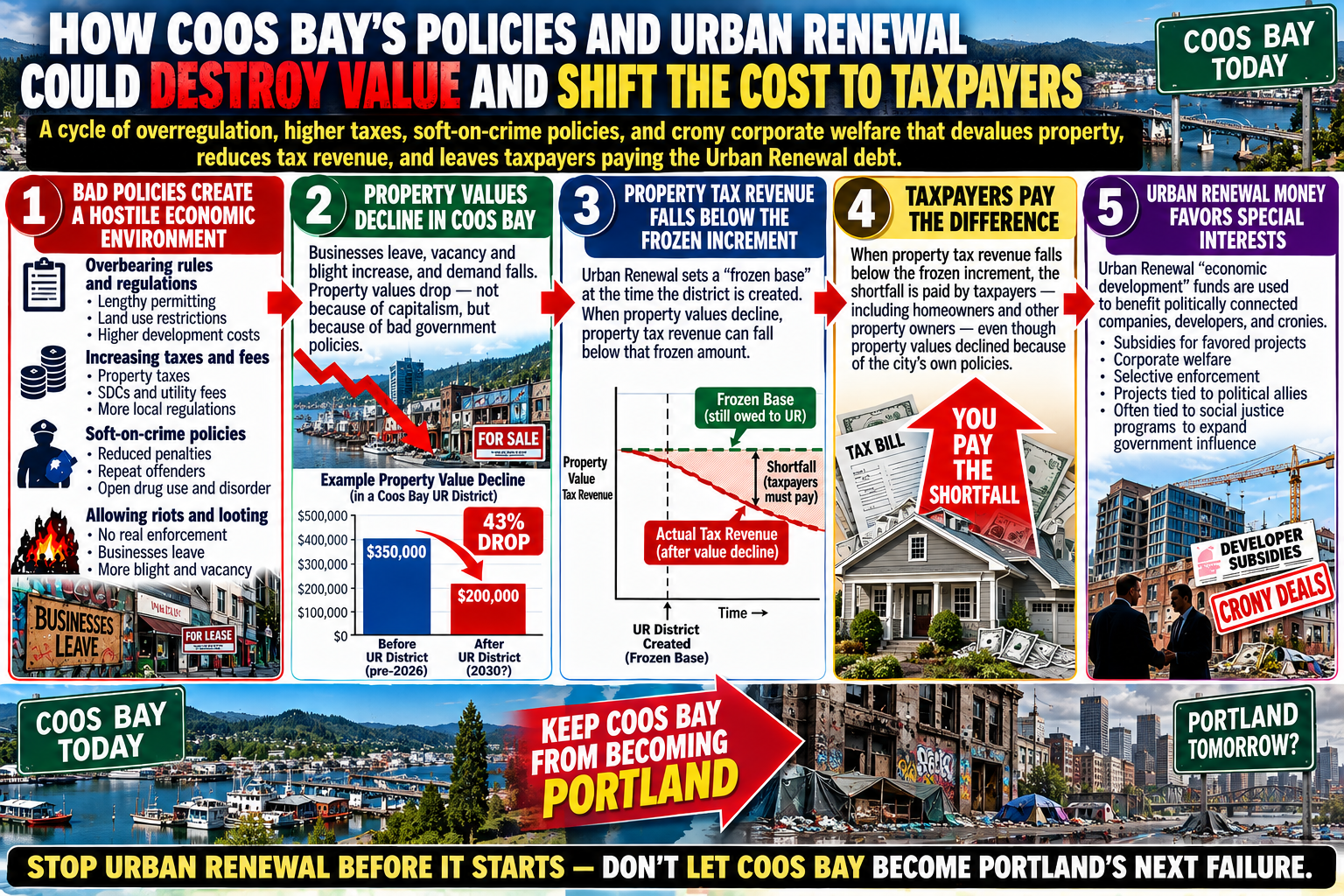
Urban renewal is not free money. It is a financing tool that shifts tax revenue away from other services so a redevelopment agency can spend it. When that money is repeatedly steered toward companies connected to a sitting hospital board chair who also leads a local nonprofit and sits on the board of a regional anti-poverty organization, the public has a right to know exactly how and why those decisions were made, who benefited, and what safeguards failed along the way.
There may be legitimate explanations for these transactions between associates of convenience who coincidentally serve on the same boards or work in the same places.
Nobody is accusing anyone of a crime, but the point of the article is to lay out the documented facts so residents, taxpayers, clients, and board members can see the full picture. If public money is being used to quietly subsidize private portfolios — through below-value sales, generous grants, or lax oversight — that is a policy choice, not an accident. Policy choices can be changed. But they cannot be changed if the people paying the bill are kept in the dark.
Legal Disclaimer: Nothing in this article is intended to allege, imply, or conclude that any individual or organization named herein has violated any law or engaged in criminal conduct. The information presented is based on publicly available records and is offered for informational and accountability purposes only.


