rob taylor report logo
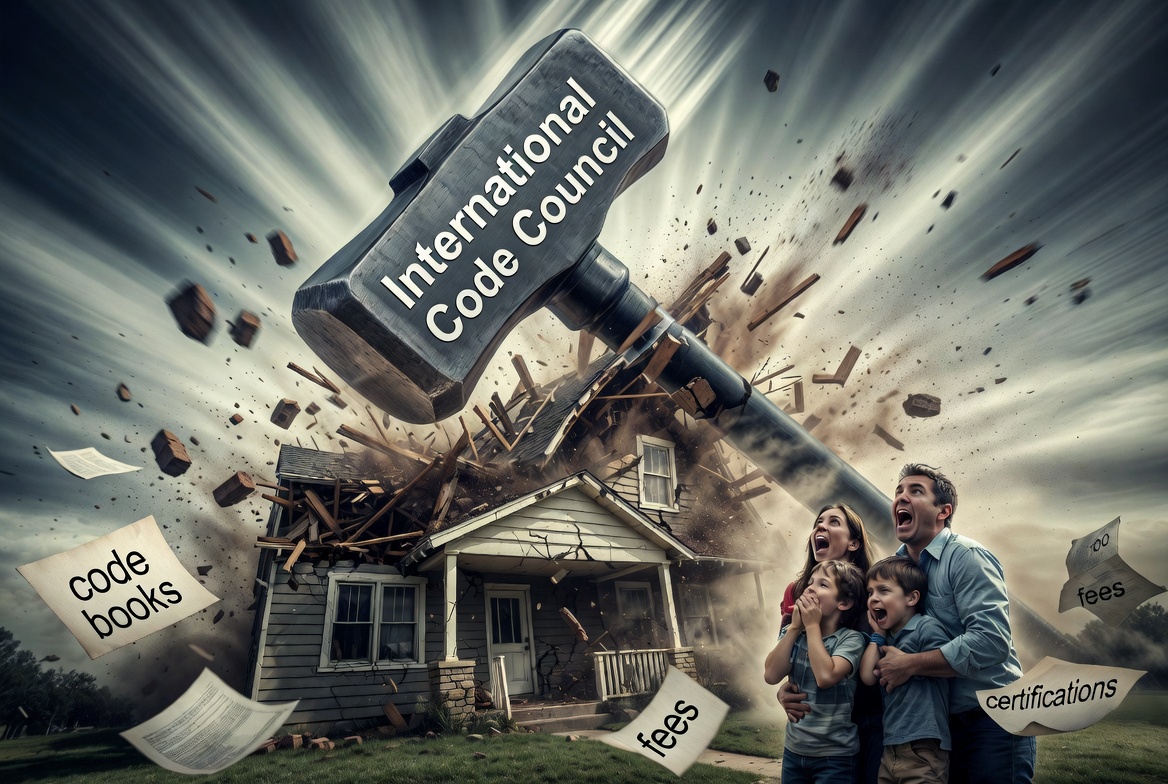
ICC Sledgehammer.jpg

Building Safety Month: How Coos Bay Promotes Costly International Building Codes

May 29, 2026

The City of Coos Bay just signed up for Building Safety Month 2026. The announcement reads like a public service campaign. Safe homes. Strong communities. Disaster preparedness. Accessibility for all.

Nobody argues against those things.

But here is what the press release does not mention.  The International Code Council updates its codes every three years and has spent $712,500 on lobbying in 2024 alone.

The ICC is not a government agency. It is a private nonprofit that sells model building codes to local governments. Those codes carry no legal weight until your city council votes to adopt them. But once adopted, they become law. And the costs get passed directly to homeowners and renters.

Coos Bay residents deserve to know what they are buying into.

As the month progressed, the city's weekly announcements revealed something more than public education—a promotional campaign for the ICC's business model.

Week Two: The Promotional Campaign Continues

This week, Coos Bay released its second Building Safety Month announcement. Week 2 celebrates "Voices of the Built Environment"—the building inspectors, code officials, plans examiners, and permit technicians who enforce ICC codes.

The announcement reads like a recruitment brochure. It praises building safety professionals who "work tirelessly to protect the public." It encourages residents to "let your voice be heard" by advocating for building safety to local leadership and sharing information on social media.

It tells readers to "always check with your local building safety department before beginning home improvement projects" because "many building safety departments require permits for home improvement projects, including electrical, mechanical, structural, or plumbing work."

The messaging is clear: Building codes keep you safe. Code officials protect you. You need permits. You need inspections. You need compliance.

What the announcement does not mention:

  • The codes that professionals enforce add $15,000 to $31,000 to the price of a new home.

  • Code violations cost homeowners $12,000 to $25,000 per occurrence to remediate

  • The ICC generates $136 million annually, selling the codes, training, certifications, and materials that make this system run.

  • Oregon already customizes and adopts ICC codes at the state level—Coos Bay's ICC membership is optional, not required.

Week 2 also encourages residents to "become a building safety professional" and highlights career opportunities in the field. It is a promotional campaign for an industry built on mandatory compliance with codes written by a private organization.

The announcement closes with a call to action: "Talk to your network about building safety and share fact-based information."

Here is some fact-based information the city did not share.

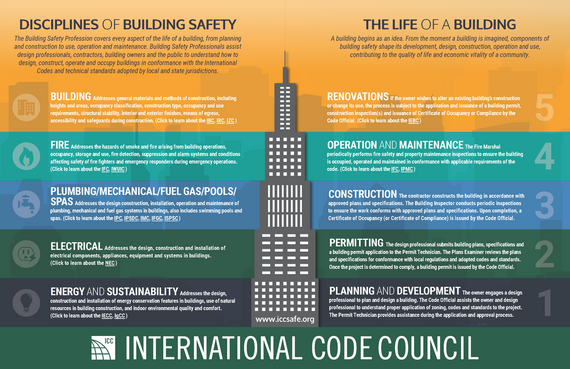
Photo provided by the city newsletter:

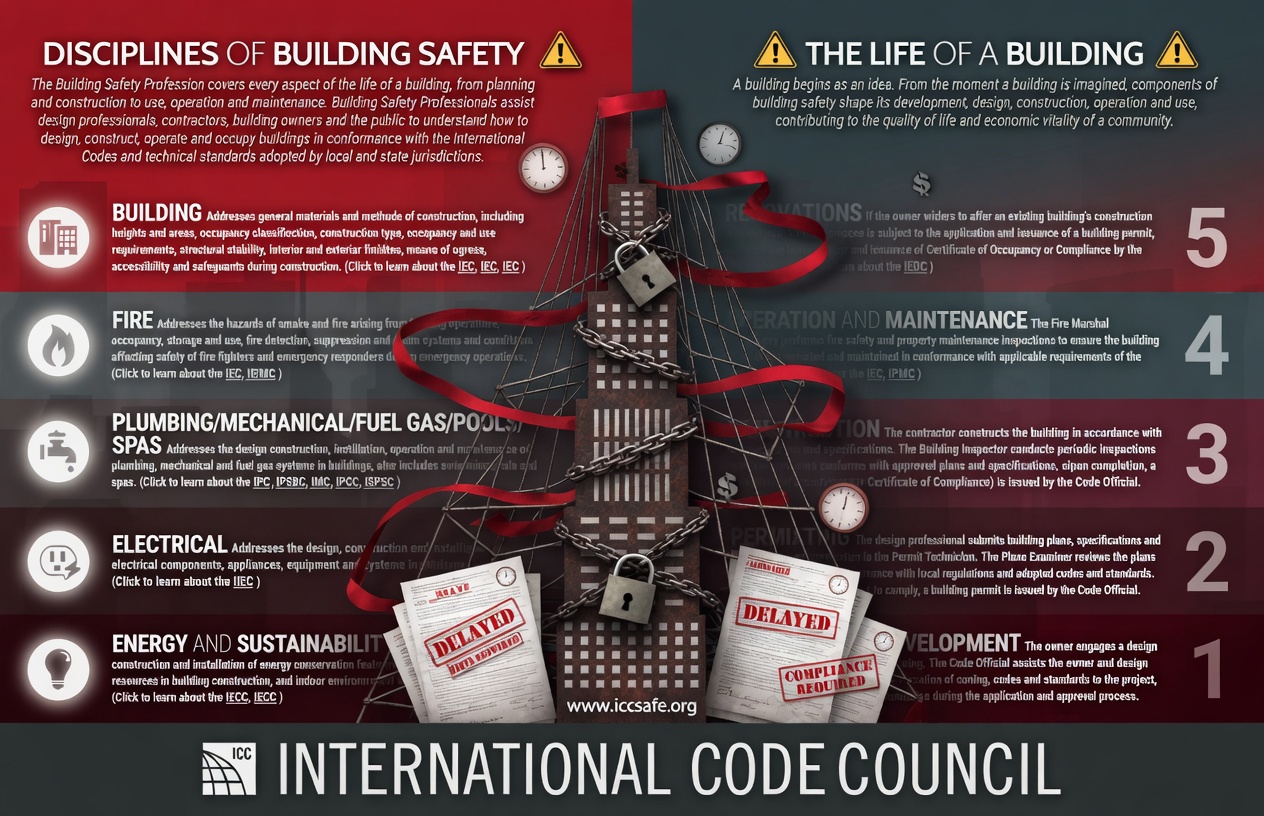
Photo redone to reflect the chains of the planners:

Week Three: Using Fear to Sell Code Adoption

Week 3 of Building Safety Month escalates the promotional campaign with a new tactic: fear.

The city's latest announcement focuses on "disaster resilience"—earthquakes, floods, hurricanes, wildfires. It paints a picture of vulnerable communities at risk from natural disasters and positions ICC building codes as the solution.

The messaging is clear: Modern building codes save lives. Your community needs the latest codes. You should demand them.

The announcement includes emergency planning tips, retrofit recommendations, and disaster preparedness checklists—all sensible advice. But then comes the call to action.

"Demand Building Safety"

Under a section titled "Demand Building Safety," the announcement directs residents to:

  • Visit the Federal Alliance for Safe Homes (FLASH) website to check whether their community has adopted the latest model codes.

  • Visit the ICC's own code adoption map to determine if the state or community has "up-to-date codes."

  • Find contact information for elected officials and "ask for change" if the latest model code has not been adopted.

  • Share "details on why adopting and enforcing modern building codes is important."

It is not a public service announcement. This is political organizing.

The city is using taxpayer resources and official communication channels to encourage residents to lobby elected officials to adopt the ICC's latest codes—codes that add $15,000 to $31,000 to the cost of a new home.

The announcement does not mention those costs. It does not mention that Oregon already customizes ICC codes at the state level. It does not mention that many states reject certain ICC provisions due to cost and local-control concerns.

It simply uses disaster scenarios to create urgency and directs residents to pressure their representatives to adopt "up-to-date" codes.

What Week 3 Does Not Mention

The announcement lists disaster resilience measures that sound reasonable on their face:

  • Seismic retrofits that strengthen foundations

  • Flood-resistant design with elevated utilities

  • Hurricane-ready features like impact-rated windows

  • Wildfire-resistant construction using ember-resistant vents

What it does not mention:

  • Retrofit costs: Seismic retrofits for older homes can cost $10,000 to $50,000, depending on the structure

  • Impact-rated windows: Hurricane-rated windows cost 50% to 100% more than standard windows

  • Wildfire-resistant materials: Non-combustible roofing, siding, and vents can add $20,000+ to construction costs

  • Mandatory versus voluntary: The announcement does not distinguish between voluntary upgrades homeowners can choose and mandatory code requirements enforced by the local government.

Disaster preparedness is important. But using fear of earthquakes and wildfires to sell building code adoption—without disclosing the costs or distinguishing between voluntary safety measures and mandatory compliance—is manipulative.

The Real Cost of "Resilience"

The 2024 IECC includes provisions for "climate resilience" that go beyond traditional safety codes. These provisions align with the ICC's participation in UN climate conferences and its promotion of sustainability goals through building codes.

When your city promotes "disaster resilience" through ICC codes, it is not just about earthquake safety. It is about embedding climate policy into local building regulations—policy decisions that should happen through transparent legislative processes, not through model codes adopted by local councils under the banner of "safety."

Week 3's call for residents to "demand building safety" by lobbying for the latest ICC codes is particularly revealing. The city is actively recruiting residents to pressure elected officials into adopting more expensive code requirements—without providing residents with information about what those requirements would actually cost.

It is not public education. That is marketing on behalf of the International Code Council.

Week Four: The Call to Action

The final week of Building Safety Month uses accessibility and inclusivity—values nobody opposes—to close the campaign with a direct call to political action.

Week 4 focuses on "Communities Without Limits," promoting accessible design in accordance with the ADA Standards for Accessible Design, the Fair Housing Accessibility Guidelines, and ICC A117.1. The messaging emphasizes step-free entrances, grab bars, accessible parking, and emergency evacuation features for people with disabilities.

This is uncontroversial. Accessibility is important. Nobody argues against accommodating people with disabilities.

But then comes the real purpose of Week 4: a five-step political organizing playbook directing residents to lobby elected officials to adopt the ICC's latest codes.

The Five-Step Playbook

The city's announcement provides residents with explicit instructions:

Step One: Visit the Federal Alliance for Safe Homes website and enter your zip code to check your home's "model code status."

Step Two: Visit the ICC's code adoption map to determine if your state has adopted "up-to-date codes."

Step Three: Identify which officials to contact—building officials, city council members, county commissioners, or state legislators.

Step Four: Attend city council meetings or state board meetings, or contact legislators by phone, email, or in person.

Step Five: Use ICC-provided talking points to "ask for change."

The announcement even provides the specific arguments residents should make when lobbying officials, including claims that modern codes "reduce the cost of living" and do so "without impacting housing affordability."

That claim directly contradicts the National Association of Home Builders' documented evidence that ICC code changes add $15,000 to $31,000 per home.

What Week 4 Does Not Mention

The announcement cites a National Institute of Building Sciences study claiming ICC codes generate "$11 for every $1 invested in mitigation and recovery costs." It does not mention the upfront costs that disqualify families from mortgages today.

It does not mention that Oregon already adopts ICC codes at the state level, meaning Coos Bay residents would be lobbying for codes the state has already customized and adopted.

It does not mention that ICC membership is optional, not required, for code enforcement.

And it certainly does not mention that the city spends at least $3,687 annually on ICC compliance.

This Is Political Organizing

Building Safety Month is not a public awareness campaign. By Week 4, the city is using taxpayer resources and official communication channels to recruit residents to lobby elected officials on behalf of an international organization's regulatory agenda.

The arc is complete:

  • Week 1: Announce participation

  • Week 2: Celebrate code enforcement professionals

  • Week 3: Use disaster fear to create urgency

  • Week 4: Provide a step-by-step lobbying guide using accessibility as emotional cover

That is not education. That is marketing on behalf of the International Code Council.

How It Works in Oregon: State Adoption, Local Enforcement

Oregon operates under a statewide building code system that adds an extra layer to the ICC's business model.

The State of Oregon adopts the ICC's national model codes and customizes them for Oregon through its Building Codes Division. Cities like Coos Bay then administer and enforce those state-adopted codes locally. Membership in the ICC is not required for cities to enforce Oregon's building codes.

But here is where it gets interesting: Coos Bay paid $405 for a three-year ICC membership anyway.

According to City Manager Nichole Rutherford, the membership provides "discounted training and resources" for staff. The city has also paid for coursework, certifications, and access to code books—all to comply with codes that Oregon already mandates at the state level.

The ICC does not just sell codes to states. It sells the training, certifications, and materials that cities need to enforce those codes. And it collects membership fees from cities that want discounts on those services.

It is a self-perpetuating revenue model.

The ICC's Business Model: Sell the Code, Then Sell the Updates

The International Code Council generated over $136 million in revenue in 2024. Between 85% and 90% of that comes from what they call "program services." That is a polite term for selling code books, certification exams, product testing, and compliance software to builders, inspectors, and local governments.

Here is how it works:

Step one: The ICC develops a "model code" through a consensus process involving industry stakeholders, manufacturers, and government officials.

Step two: In Oregon, the state adopts that model code, customizes it, and makes it law statewide. Cities like Coos Bay must enforce it locally.

Step three: Every builder, contractor, and inspector in Coos Bay must purchase the updated code books and pay for new training.

Step four: Three years later, the ICC releases an updated version. Repeat.

The National Association of Home Builders documented the impact of just two code cycles. The 2009 IRC changes added between $6,100 and $16,100 per home. The 2012 updates added another $4,900 to $13,800.

Those costs do not disappear. They get baked into housing prices.

Who Actually Writes These Codes?

The ICC promotes itself as a neutral safety organization. In 2019, the New York Times reported on a working agreement between the ICC and the National Association of Home Builders that allowed the construction industry to provide input on code development. Congress examined the process.

The real controversy came later that year when something unexpected happened.

Hundreds of local government officials registered to vote on ICC code changes after noticing that previous rounds had improved energy efficiency by only 1%. Their participation led to new measures that improved efficiency by up to 14% under the 2021 energy code—a dramatic increase driven by environmental activists mobilizing government employees.

The ICC's response? In March 2021, the Board of Directors eliminated government members' voting in the final determination of the International Energy Conservation Code. Over 75% of public comments opposed the change.

Local officials who had been manipulated by environmental groups to impose costs on private property owners lost their voting power. A smaller standards committee gained it.

Environmental groups immediately cried foul. Building Green reported that the ICC restructured the process "in reaction to city and government officials voting to significantly green the code in 2019." The National Association of Home Builders praised the change.

Here is what nobody wants to say out loud: democratizing control over private property is mob rule. When government officials vote to impose tens of thousands of dollars in additional costs on individual homeowners and builders, that is not democratic code development. That is collectivism.

The American Gas Association: Defending Property Owner Choice

Look at who is funding this year's Building Safety Month campaign. The American Gas Association serves as the Foundation Sponsor for Building Safety Month 2026.

Critics claim this creates a conflict because AGA opposes electric building code mandates. Proponents of less regulation believe the AGA is defending property owners' right to choose their own energy sources.  The AGA is not doing it because of their humanitarianism, but because it is economically beneficial to their industry.  

AGA President Karen Harbert stated the organization has "an extensive history partnering with the International Code Council." That partnership became crucial when the 2024 International Energy Conservation Code attempted to mandate that all new buildings be "ready" for electric appliances—essentially forcing property owners to pay for infrastructure they might never use.

The National Association of Home Builders and the American Public Gas Association filed formal appeals. The ICC Board upheld parts of those appeals, moving controversial measures like mandatory EV charging circuits and heat pump readiness from the required code to an optional appendix.

That is not industry influence corrupting the process. That is the industry defending individual property rights against ideologically driven mandates. Property owners should decide whether to invest in electric infrastructure, not government bureaucrats implementing environmental agendas through building codes.

What the 2024 IECC Actually Costs

The U.S. Department of Energy claims the 2021 IECC increases upfront costs by $2,000 to $5,000 but saves homeowners an average of $2,300 to $4,000 over a 30-year mortgage through lower utility bills.

The National Association of Home Builders tells a different story. Their analysis argues that the 2021/2024 updates can add $15,000 to $31,000 to the price of a new home due to requirements such as "electric-ready" circuits, continuous insulation, and advanced air sealing.

Even if we accept the lower government estimate, a 20-year payback period for energy savings does not help families who are disqualified from a mortgage today because house prices have risen by 5%.

Code violations discovered during construction cost an average of $12,000 to $25,000 per occurrence to remediate. That includes demolition, redesign, resubmittal, and reconstruction.

The complexity creates financial landmines for builders and homeowners.

States Are Rejecting ICC Provisions

Most states adopt the International Residential Code, but many strip out specific chapters they find too expensive or intrusive.

Residential fire sprinklers are the most-rejected provision in ICC history. Despite the ICC making them mandatory in the 2009 IRC, most states have blocked the requirement:

  • Oregon specifically deletes the requirement for mandatory sprinklers in one- and two-family dwellings.

  • Pennsylvania passed a law allowing builders to opt out, provided they offer customers the option at their own cost.

  • Texas and Missouri prohibit municipalities from mandating residential sprinklers unless approved by local referendum.

North Carolina and Ohio have maintained older versions of the Energy Code to preserve housing affordability. Arizona's legislature has considered bills to limit how far cities can go in mandating gas bans or EV readiness.

When states consistently reject provisions, it raises questions about whether those provisions serve safety or other interests.

The UN Connection

The ICC participated in the UN Global Climate Change Conference (COP30) in November 2025. The organization joined ministers from nearly two dozen countries at the Inter-Governmental Council for Buildings and Climate, which launched the Belem Call for Action, affirming that "regulatory action is required" to achieve sustainability goals.

The ICC has no formal legal connection to Agenda 21 or the 2030 Agenda for Sustainable Development. But it aligns its professional standards with those broader international sustainability goals.

The ICC's International Green Construction Code is designed to help local governments improve the environmental performance of buildings. Critics view these "green" regulations as the local implementation of UN sustainability principles.

The ICC maintains it is a private nonprofit with no authority to mandate policy. Local officials can modify or reject sustainability measures entirely.

But here is the reality: once your city adopts an ICC code, those sustainability measures become local law. The "voluntary" nature disappears.

What Coos Bay Actually Bought: The City Manager Responds

After inquiring about the city's relationship with the ICC, City Manager Nichole Rutherford clarified that it reveals both more and less than the initial announcement suggested.

According to Rutherford, in November 2024, Coos Bay paid $405 for a three-year membership to the International Code Council. That works out to $135 per year—less than the typical $315 annual fee for cities of comparable size.

But the membership fee is only part of the story.

Why join at all? According to the City Manager, "Membership to ICC allows for discounted training and resources." The city has also paid for coursework and certifications for staff members, as well as access to codebooks and materials adopted at the state level.

In other words, Coos Bay is paying the ICC for:

  • Discounted training on codes the state already mandates

  • Certifications required to comply with the statewide system

  • Access to code books that get updated every three years

  • Voting rights on code changes (unless those votes produce outcomes the ICC Board does not like)

  • Participation in Building Safety Month (sponsored by the American Gas Association)

What the City Manager Revealed

When asked about the total costs beyond the $405 membership fee, the City Manager explained that she would have to "do some digging" and that gathering the information might exceed the city's 15-minute public records request limit because ICC-related expenses are tracked across multiple budget accounts.

ICC compliance costs are not consolidated in a single line item—they are spread throughout the city's budget.

When asked why the city chose to join the ICC despite membership not being required, Rutherford was candid: "I do not know enough about ICC membership, coursework, or certifications." This is reasonable—city managers oversee multiple departments and cannot be expected to know every detail of every professional membership. The Building Official would have that specialized knowledge.

She compared the ICC membership to professional organizations like the Oregon Government Finance Officers Association—memberships the city has not held "for quite a while" because they were not cost-effective.

Rutherford also acknowledged uncertainty about whether the city will continue the ICC membership, noting it "would be a department head level decision" based on "benefit versus the cost."

How ICC Costs Are Structured

When asked to provide the detailed ledger for ICC-related training and certification costs, City Manager Rutherford promptly ran the building code training account for FY26 and provided the data.

In her initial response, she noted: "I'll need to check where certification expenses are posted. I also see that we might have to approach this a bit differently (accrual accounting challenge), so let me think on the quick version of getting you helpful info."

ICC-related expenses are scattered across multiple budget accounts: training costs in one, certification expenses in another, and code books in yet another. This is standard municipal accounting practice, not a deficiency.

Despite this complexity, City Manager Rutherford successfully obtained the complete cost data from multiple accounts and provided it without charging public records fees—demonstrating both transparency and exceptional cooperation.

Residents see "Building Safety Month." They do not see the scattered invoices for ICC coursework, staff certifications, updated code books, and the hours spent tracking regulatory changes every three years.

The Numbers: What One Account Reveals

City Manager Rutherford provided the detailed ledger for the Building Code Training account (08-304-520-2005) for Fiscal Year 2026 (July 2025 through May 2026).

Here is what one budget account shows:

Total training expenses so far this fiscal year: $1,495.01

Annual budget for this account: $2,500.00

The expenses break down as follows:

  • $55.01 – Prepaid expense carried over from FY25

  • $125.00 – Oregon DCBS training certification (Goodrich)

  • $750.00 – State of Oregon DCBS Residential Inspector Training (Goodrich)

  • $280.00 – State of Oregon DCBS exam fee (Goodrich)

  • $35.00 – City County Insurance Services training (Goodrich)

  • $250.00 – PermitTechNation permit tech training (Gannett)

This is just one account for one fiscal year. And remember what the City Manager said: "I'll need to check where certification expenses are posted."

This ledger does not include:

  • Certification expenses (posted in a different account)

  • The $405 ICC membership (different account)

  • Code book purchases (likely a different account)

  • Staff time spent reviewing code updates and attending training

And this is an annual recurring expense. As codes update every three years and staff require recertification, these costs repeat year after year.

So when the city says ICC membership costs $135 per year, that is technically accurate. But the compliance system that membership supports costs the city at least $2,500 annually just for training—and that is before adding certifications, code books, and staff time.

The Real Costs

City Manager Rutherford went "contrary to norms" to obtain detailed certification cost data, revealing the full picture:

When expenses are compiled, Coos Bay pays annually:

  • ICC membership: $170

  • Oregon Building Officials Association: $415

  • Training budget: $2,500

  • Code books (amortized): $602

  • Certification exams and renewals: varies

Minimum annual baseline: $3,687 before exams, coursework, renewals, and staff time.

Every three years, when codes update, add $1,807 in new code books plus retraining costs.

The $135-$170 annual membership is just the entry fee. The real recurring costs are in the thousands.

To be clear: City Manager Rutherford works at the direction of the City Council and implements their policies. Her candid responses were professional and transparent. The City Council joined this organization and signed up for its promotional campaign—accountability for that decision lies with them, not with city staff.

The City Manager Explains the Catch-22

After receiving the city's Week 2 Building Safety Month announcement, a follow-up exchange with City Manager Rutherford revealed something more significant than budget details: an acknowledgment of the regulatory trap local governments face.

When asked about coursework and certification costs, Rutherford offered to run a detailed ledger within the 15-minute public records limit. But more importantly, she acknowledged the underlying tension:

"I appreciate your acknowledgment of the hoops we get to jump through as local governments. We are as close to grass roots as possible, are often working with a 'what's best for our community' intent because we live here and raise our families here, but then have those government layers above us adding complexity to fairly straight forward work."

This is a rare admission: State mandates force local governments to spend money on compliance systems created by private organizations.

The catch-22: Cities must enforce state-adopted codes and maintain certified staff, but must also control costs without raising fees.

Local governments become middlemen—enforcing codes they did not write, paying for training they must have, passing costs to residents who have no say.

She is implementing policies set by the City Council under state mandates.

The critical question is: How much of that complexity serves safety, and how much serves the ICC's revenue model?

Is ICC Membership Required?

No. City Manager Rutherford was explicit: "Membership in the ICC is not required to enforce Oregon's building codes."

Coos Bay could meet all state requirements without ICC membership. The city would still:

  • Pay Oregon DCBS directly for required training and certifications.

  • Purchase training from other providers like PermitTechNation

  • Maintain membership in the Oregon Building Officials Association ($415 annually)

  • Buy code books from publishers.required

The trade-off? Without ICC membership, the city would lose the discount pricing on code books and training materials. The ICC membership ($170 annually) provides access to those discounts.

So the question becomes: Does the $170 membership save more than $170 in discounts—or is the city actually spending more?

City Manager Rutherford's comparison is revealing: the city discontinued memberships in the Oregon Government Finance Officers Association because they were not cost-effective.

But here is the real issue: Organizations like the ICC only have influence when governments make their standards mandatory.

The ICC exists to develop codes and make recommendations. That is their right as a private organization. The problem is not the ICC—the problem is state legislatures adopting ICC codes into law, forcing local governments to enforce them, and creating a captive market for the ICC's products and services.

Without state mandates, the ICC would be just another trade association offering voluntary best practices. With state mandates, they become de facto regulators profiting from mandatory compliance.

Code regulations should be limited. The state forces cities and counties to abide by laws the legislature creates. Private organizations will always exist and advocate for their interests—but their influence only becomes consequential when government gives it the force of law.

That is where accountability belongs: with the Oregon Legislature that adopts these codes and with the City Council that decides how much to spend to comply with them.

What the Membership Actually Supports

The city is buying compliance with a system that generates revenue from government mandates.

Even though Oregon customizes ICC model codes at the state level, the city still signals alignment with an organization that:

  • Spent over $700,000 on lobbying in 2024

  • Changed its voting rules after local governments voted for stricter environmental standards

  • Has been criticized by housing policy analysts and research organizations for inflating housing costs through arbitrary and stringent standards

  • Participates in UN climate conferences to promote building codes supporting international sustainability goals

The Cato Institute notes that "building code changes adopted just since 2012 account for 11 percent of the cost of building new apartments."

Questions for the City Council

Did the City Council know that ICC codes add $15,000 to $31,000 to the price of a new home before signing up for Building Safety Month?

Did they know the ICC eliminated governmental voting power in 2021?

Why pay for ICC membership when it is not required to enforce Oregon's codes?

Did they know the city spends a minimum of $3,687 annually on ICC compliance—21 times the stated membership fee?

These are questions residents should ask at the next city council meeting.

City Manager Rutherford has been responsive and transparent throughout this inquiry. The questions above are directed at the City Council's decision-making process, not the City Manager's performance.

The Bottom Line

The ICC has moved beyond basic safety into social engineering through building codes—energy mandates, electric-ready requirements, and sustainability metrics aligned with UN climate goals.

But the fundamental question is even more basic: Who should decide how a property owner builds on their own land—the property owner, or government bureaucrats enforcing codes written by a private organization?

These are policy decisions that affect individual property rights. They should not be decided through a private nonprofit's model code rubber-stamped by state legislatures and local councils. Most importantly, they should not override property owners’ rights to make their own decisions about construction, materials, and design.

Building Safety Month promotes a business model that turns government mandates into private revenue.

Back to Blog